
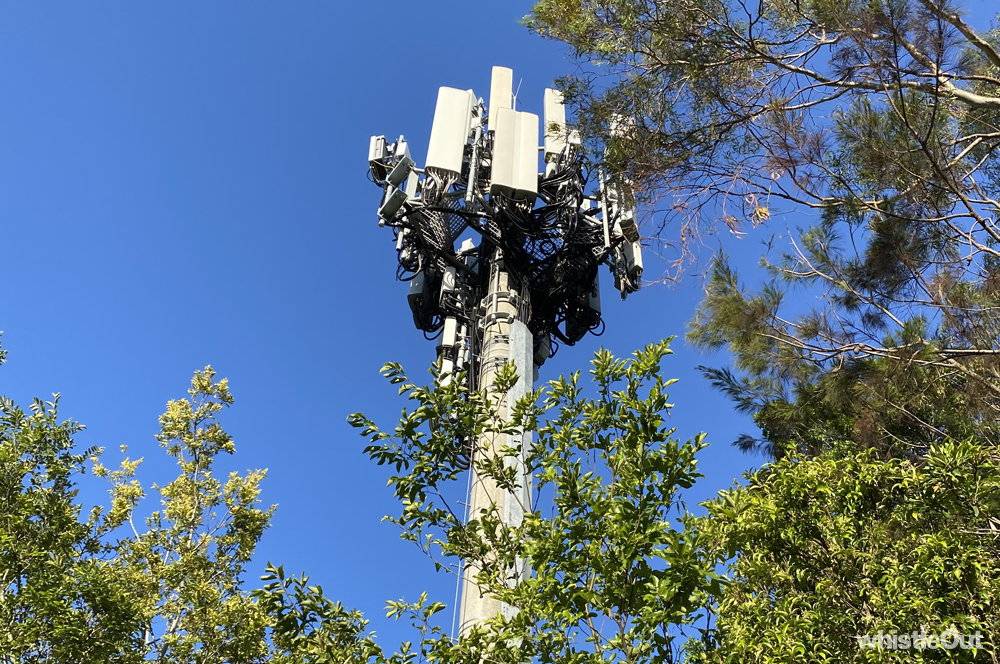
5G has long been hailed as an NBN killer, but not everyone agrees. Australia's two largest mobile providers are almost polar opposites when it comes to their 5G networks. Telstra is taking a mobile-first approach to 5G, pushing the latest handsets and promising blistering download speeds. Optus has made at-home 5G its priority, and is a little more modest in its claims around performance.
Speaking at a 5G gaming media event recently, Telstra Group Executive for Consumer and Small Business, Michael Ackland, said he believes fixed-line connectivity - such as the NBN - will still play a role in dealing with big downloads, such as new release video games.
"I don't think there is a future where that fixed experience won't play a role in dealing with large data downloads," said Ackland. "I think you've got to look for a range of connectivity experiences to [address large downloads]. 5G will not solve all of those issues."
Instead, Ackland says we'll increasingly see people using 5G in tandem with their NBN connection.
There are of course limitations to mobile networks. While 5G promises faster data speeds and more capacity, a physical network is still less prone to congestion. However, the bigger issue for Telstra customers right now is data allowances.
At present, Telstra's mobile plans cap out at 150GB per month, and its mobile broadband plans at 100GB. These limits would prove insufficient if someone were to download 120GB of the recently released Call of Duty: Modern Warfare.
Telstra previously offered a truly unlimited data mobile plan for $199, but this was discontinued as part of its plan refresh in the middle of this year. Ackland says Telstra currently has no plans to bring back a truly unlimited mobile offering. (Telstra mobile and mobile broadband plans have no excess data charges if you go over your allowance, but are limited to speeds of 1.5Mbps.)
Ackland didn't rule out more robust 5G plans capable of larger downloads, but said that Telstra stills need to work out how to facilitate "the different experiences that people want" over a 5G connection.
While there are certainly limits to what a 5G connection is capable, parts of the telco industry certainly believe in its potential as an alternative to the NBN.
Optus' core 5G product is 5G home wireless broadband, a service that's almost explicitly pitched as an NBN alternative. It's a $70 per month plan with unlimited data and speeds of at least 50Mbps. That's the same price as Optus' NBN 50 plan, but speeds could potentially be faster.
When asked about the network's capacity to support large downloads, Optus CEO Allen Lew seemed confident that heavy users won't cause congestion.
"Right now we have a 5G network that's built up across close to 300 base stations that's totally empty," said Lew. "There's hardly anybody using it. 5G is much more efficient and it's purposely built for high data throughput, so that allows us to [facilitate large downloads]."
In addition, Lew reiterated the telco's network satisfaction guarantee.
"We will make sure that every home customers get the minimum speed of our commitment: 50Mbps. In the unlikely event the capacity of the network gets exceeded, we will not connect any more customers [until further capacity is available]."
Optus 5G home wireless customers who find themselves experiencing speeds of under 50Mbps can make a claim and cancel their service with no penalty. While 50Mbps is comparable to what many customers are getting on the NBN, it's a far cry from 1Gbps plus speeds 5G is capable of. Optus says that the 200 or so customers currently using its 5G home service are currently experiencing average speeds of 164Mbps at peak times, with speeds reaching as high as 400Mbps during less busy periods.
Boost Mobile founder Peter Adderton is even more confident in 5G's viability as a fixed-line internet replacement, suggesting that it's potential as an NBN alternative is 5G's "killer app".
"The world of getting a fixed-line [connection] into your house is gone," said Adderton. "That's where 5G is going to have a real advantage. That's where 5G is going to attack, it's going to attack broadband."
Adderton pointed to the plug-and-play nature of 5G as one of its key advantages over an NBN connection. Products such as Optus' 5G home wireless broadband can be used as soon as the modem arrives. There's no need for technicians or physical installation.
Alex Choros

Related Articles


