
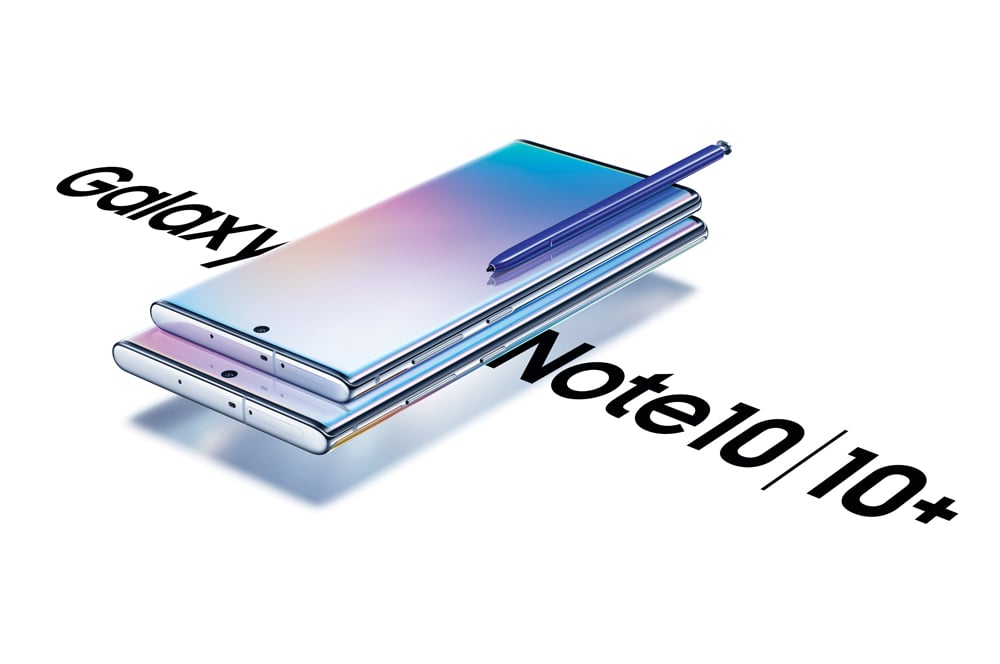
After a particularly leaked pre-launch season, Samsung officially took the wraps off the Galaxy Note 10 at the start of the month. As we expected, it's no longer just a single phone: this time around you can pick from a "regular" Galaxy Note 10, or an even larger Galaxy Note 10+. And for those living on the bleeding edge, there's also a 5G variant of the Galaxy Note 10+.
The Note 10 and Note 10+ succeed last year's Note 9, with both phones featuring curved displays with a camera cut-out, an ever increasing array of rear-facing cameras, and an in-screen fingerprint reader. The S Pen is back too, obviously.
The standard Note 10 will set you back $1,499, the Note 10+ is priced at $1,699 and if you're after the Note 10+ 5G, you'll pay $1,999. Below is a small selection of Note 10+ plans, or click here to see more.

Samsung Galaxy Note 10 and Galaxy Note 10+: What's New
The biggest change to this year's Note devices is that there's two. While the Note flagships have typically stood alone, you've got two to pick from this year: the 6.3-inch Galaxy Note 10 and the slightly larger 6.8-inch Galaxy Note 10+.
Both the Galaxy Note 10 and Galaxy Note 10+ take more than a few cues from this year's Galaxy S10 series. As with the S10 devices, Samsung has reduced bezel with a camera cut-out display. Rather than sitting in a notch, the selfie camera is built directly into the screen. While the S10 family have the selfie camera in the top right hand corner, Samsung has centred it for the Note 10 and Note 10+.
Much like the Galaxy S10 series, neither phone has a physical fingerprint reader. Instead, Samsung is using in-screen fingerprint technology, as is becoming increasingly common these days. Both phones also support facial recognition.

While the pair of devices look pretty similar, the differences between the Note 10 and Note 10+ go beyond screen size.
The smaller Note 10 is almost a premium economy version of the Note 10+, making more than a few compromises to keep down the cost. The screen is smaller and runs at a lower resolution, there's less RAM, three rear-facing cameras instead of four, no expandable storage, and a much lower capacity battery. The Note 10+ also has faster charging (up to 45W), which is said to give you a full day of usage from a 30 minute charge. A 45W charger is not included in the box, however.
Here is the full breakdown of how the pair compare:
Samsung Galaxy Note 10 Specs
| Galaxy Note 10 | Galaxy Note 10+ | |
|---|---|---|
| Display | 6.3-inch 1080p+ | 6.8-inch 1440p+ |
| Processor | Exynos 9825 | Exynos 9825 |
| Storage | 256GB | 256GB |
| RAM | 8GB | 12GB |
| Rear-Facing Camera | 12MP + 12MP + 16MP | 12MP + 12MP + 16MP + ToF |
| Front-Facing Camera | 10MP | 10MP |
| Battery | 3,500mAh | 4,300mAh |
| Water-Resistance | IP68 | IP68 |
| Fast Charging | 25W Fast Charging | 45W Fast Charging |
| Price | From $1,499 | $1,699 |
As with last year's Note 9, the Note 10 S Pen is Bluetooth enabled. Essentially, this lets you use it as a remote for the Note 10. For example, you can use it to trigger the camera shutter, change the track on your playlist, or flip through presentation slides without actually touching the Note 10 screen. In addition, Samsung will make an SDK available to developers, allowing them to incorporate this kind of functionality in their apps. The most interesting new S Pen feature is that it can turn handwritten notes into text.
Much like the Galaxy S10 and Galaxy S10+, both Note 10 models have three core rear-facing cameras: a 12MP primary lens, a 12MP 2x zoom lens, and a 16MP ultra-wide angle lens. The Galaxy Note 10+ augments these with a Time of Flight lens, which is used to capture additional depth information to create more realistic looking portrait shots. The Time of Flight lens can also be used for augmented reality applications. While the cameras are pretty similar to what you'll find on the Galaxy S10, the zoom lens Galaxy Note 10 and Galaxy Note 10+ has a faster aperture which should help improve shots in lowlight.
The Note 10 series also mark the first flagship smartphones where Samsung has axed the headphone jack. You will however get a USB-C pair of buds in the box, if you haven't migrated to Bluetooth yet.

Samsung Galaxy Note 10+ 5G
In addition to the Galaxy Note 10 and Galaxy Note 10+, Samsung is launching a Galaxy Note 10+ 5G. This is essentially a 5G-enabled version of the Note 10+, and is almost identical to the the 4G variant. Other than 5G connectivity, the key difference is the Note 10+ 5G has 512GB of expandable storage, while the standard Note 10+ only has 256GB of expandable storage.
Samsung also has a 5G version of the smaller Note 10, but this won't be available in Australia.
Note 10+ Camera Gallery
Check out these camera samples taken on the Samsung Galaxy Note 10+. Click or tap on any photo to see a larger version.










Samsung Galaxy Note 10 plans
Telstra is only ranging the Galaxy Note 10+ and Galaxy Note 10+ 5G. If you order before Septembert 23, you're able to get the Galaxy Note10+ 5G for the price of the 4G-only Galaxy Note 10+. That's a saving of $12 per month if you're grabbing your phone on a 24-month repayment term.
Like Telstra, Optus is skipping the smaller Note 10. You will however be able to get the Note 10+ 5G, which makes it the first 5G phone available through Optus. The standard Note 10+ is available through Optus right now. You can also pre-order the Galaxy Note 10+ 5G, but it won't be available until September 20.
If you'd prefer the Note 10+ 5G, you'll pay $10 extra per month.
Woolworths Mobile is ranging both the Galaxy Note 10 and Galaxy Note 10+. Woolworths Mobile won't range the Galaxy Note 10+ 5G.
Vodafone is offering both Galaxy Note 10+ and Galaxy Note 10 on plans, but no Galaxy Note 10+ 5G.
Alex Choros

Related Articles


