

Sonos Arc Review: The Verdict
It may be pricey, but the Arc is Sonos' best sounding speaker to date.
What we love
- Incredible sound quality
- Sleek design
- Simple to use and mostly platform agnostic
What could be improved
- Expensive
- No rear presence
- Could be a conundrum for Sonos loyalists
85/100
Time travels quickly when it comes to tech. A smartphone is considered old after a single year. Ancient after three. The Sonos Arc succeeds the Playbar, a seven-year old sound bar. In tech years, it's a veritable fossil. While the Playbar still more holds its own, the Arc was arguably overdue. After all, a lot can change in seven years.
Atmospheric
Dolby Atmos is arguably one of the biggest innovations in sound in the last seven years. While it technically launched in 2012, it was initially limited to a tiny amount of cinemas. The new audio format has only started coming into the mainstream in recent years, but it's still far from common place. Incidentally, Dolby Atmos support is easily the Arc's biggest new feature.
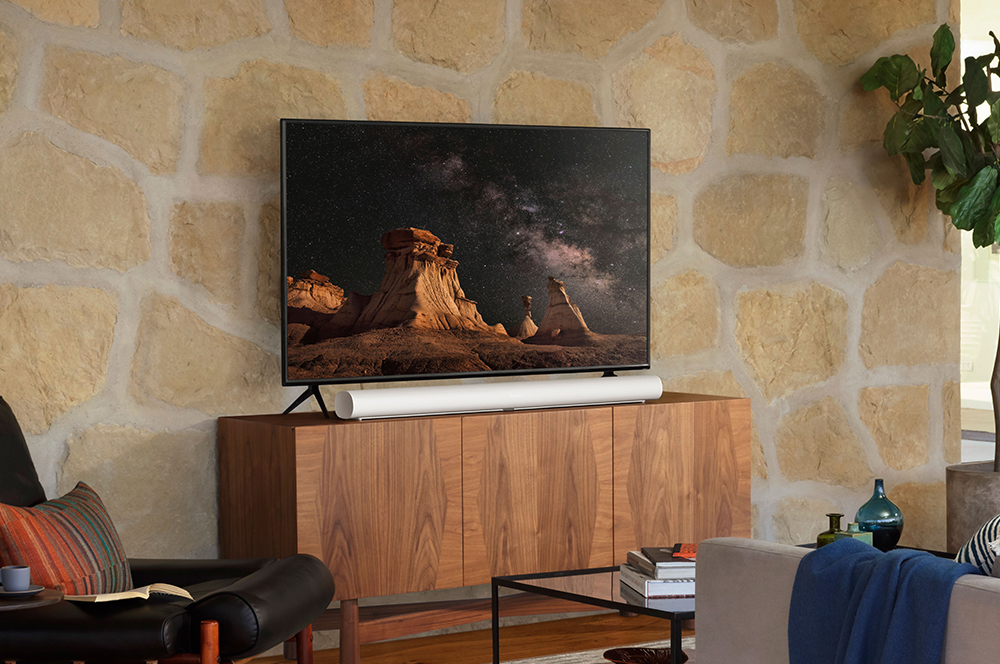
Dolby Atmos is an evolution of surround sound. In addition to positioning sound behind you and to your sides, it adds verticality. Atmos makes sound 3D. At its best, it can make it seem like rainfall or a helicopter is directly above you. The Sonos Arc is explicitly built for Atmos. It has a front right, front left, and front centre speakers, two side-facing speaker, and two upward firing speakers. All that's missing is a subwoofer.
As it stands, Dolby Atmos is far from commonplace; you'll mainly find it on movies, but not on all services. iTunes and Netflix have Atmos mixes available for select titles, but Stan and Binge don't. 4K Blu-Ray also supports Atmos, for those who prefer physical media. Atmos is far rarer when it comes to TV series, but a number of newer Netflix Originals - such as Space Force - will take advantage of the Arc.

For the most part, Atmos on the Arc adds depth and dimension, sometimes in subtle ways. Overhead noise such as helicopters are often an easy showcase for Atmos thanks to how dramatic they are, but since the Arc is a single unit, it won't necessarily create the illusion of sound directly above you. Instead, there's a clear verticality to a sound mix. In Space Force, for example, the strings in its soundtrack quite literally have an elevated presence, as if the violinists were on a higher platform than other musicians. It's not pronounced in the same way a more overt effect might be, but it helps create an immersive viewing experience. Shows not mixed for Atmos can sound flat in comparison.
The one trade-off you make with the Arc is rear sound. While it's side-firing speakers are ostensibly meant to emulate rear speakers, this isn't the case in reality. The Arc has a wide sound-stage, but it never sounds like audio is coming from behind you. This isn't exactly surprising - the only single-unit soundbar that can genuinely pull off fake rear-sound is the $3,999 Sennheiser Ambeo - but it's still nice to dream.
Atmos is far more prevalent when it comes to video content, but you can still find some music that's been remixed for the next-gen format. Unfortunately, the selection is quite limited and only available through Tidal, locked away behind the service's $23.99 per month tier.
The effect of Atmos on music is entirely dependent on the track. The Weeknd's "Starboy" is downright enveloping. The song consumes you with its presence; it fills a room in every sense. For contrast, Carly Rae Jepsen's "Call Me Maybe" isn't overly different when compared to its traditional stereo mix. The Pretty Hate Machine drumbeat will punch through your soul when played through the Arc, but you'd be hard-pressed to pick whether you're listening to the Atmos mix on Tidal or the single on Spotify.
Katrina & The Waves' "Walking on Sunshine" is perhaps a happy medium. The Atmos effects aren't in your face, but they keys have a lovely floaty quality to them, there's height to the hats and cymbals. In a similar vein, you can literally hear movement the tom beat backing Prince's "When Doves Cry". Each strike jumps up or down, gliding across the room.
Even if you're not using the Arc for Atmos content, it still sounds incredible. If whatever you're watching or listening to doesn't have an Atmos mix, the Arc won't do any upscaling unlike some other soundbars. Sonos isn't trying to add geometry the artist didn't create themselves.
In the absence of Atmos, the Arc's upward firing speakers are used to support the low-end instead, because bass doesn't have direction. Not that it needs the support, because even when you're listening to something Atmos-ready, the Arc pumps out more bass than it has any right to for a standalone soundbar.
You can, of course, still pair it with the Sonos Sub, in which case speakers responsible for low-end frequencies are repurposed. And in the same manner, if you add Sonos Ones for rear-facing speakers, the side-firing speakers get moved to treble duty.
But even if you're just using the Arc by itself, as I did for the sake of this review, it sounds fantastic. It's hard to fault.
One other key difference between the Arc and the Playbar is how you connect them to your TV. The Playbar used an optical connector, while the Arc uses HDMI ARC. If your TV doesn't have a HDMI ARC port, you'll miss out on Atmos functionality, but there's a HDMI-to-optical dongle in the box so you can still hook it up.
Software split
Like all Sonos products, the Arc is wonderfully simple. Setup is a breeze, requiring little more than an app install, a few taps on your screen, and the press of exactly one button.
The Sonos ecosystem is about as platform agnostic as possible. You can use the Arc as either a Google Assistant or Amazon Echo smart speaker, and there's also support for Apple AirPlay 2. And no matter what music streaming service you use, there's a 99.9% chance it has an Arc integration.
To borrow a phrase from the Apple playbook, the Arc just works. And it works in the way you want it.
But if you're already in the Sonos ecoystem, the Arc could potentially create a conundrum. The Arc is the first new Sonos speaker to require its new S2 operating system. S2 speakers aren't compatible with speakers running Sonos' current operating, now known as S1. This means you'll need to update any existing Sonos speakers you own to S2 before you're able to use them in a group with the Arc.
However, some older speakers can't be upgraded to S2. These included the first generation Play:5, the first generation Connect, the first generation Connect:Amp, the Bridge, the CR200, and all Zone Players.
If you have a mix of older Sonos speakers that can't upgrade to S2 and a new device like the Arc, you'll run into a problem. You can keep older speakers running S1 - they'll still remain supported by Sonos - but they won't be able to interact with S2 speakers. This means you can't have an original Play:5 in the same speaker group as an Arc. If you go down this path, you'll end up with two separate Sonos groups: one controlled by the original S1 app, one controlled by the new S2 app.
If that doesn't sound ideal, you can trade-up your S1 speakers. Sonos will offer you a 30% discount on newer models if you have hardware that is effectively discontinued. While you previously had to brick your older speakers to get the discount, this is no longer the case. It's not an ideal situation, but it’s an option at the least.
It's understandable that there are limits to how much you can keep supporting old tech with new upgrades. You're going to run into limits at some points. It's just a pity that Sonos' most loyal customers are likely to be the ones affected by this schism. If you've got a few "legacy" Sonos speakers, the fact you'd need to split or upgrade your ecosystem could potentially be enough to dissuade you from buying an Arc.

Sonos Arc - Final Thoughts
The Sonos Arc is a fantastic soundbar. It's easily the best sounding speaker in the Sonos ecosystem, and one of the best speakers I've had the pleasure of listening to. Of course, at $1,399, it's also the most expensive product in the Sonos ecosystem.
The Arc is worth the money for those willing to spend it, even as a standalone speaker. Adding a Sub or a couple of Sonos Ones will enhance your experience, but it's certainly not necessary. There's enough bass response where the Arc doesn't feel lacking, and while it can't create rear-facing sound, it has a staggeringly wide sound-stage. Even if you're not watching or listening to Atmos content. It flat out sounds incredible whether you're watching your favourite show or cranking your favourite tunes.
As a piece of tech, the Sonos Arc will inevitably have a used by date. At some point, it will become legacy hardware splintered off from the rest of the Sonos ecosystem. It's an inevitable fate that awaits any piece of technology. But at the least, the Playbar had a seven year run in stores. It will continue to be supported for the foreseeable future. And even if Sonos stops updating the Playbar at some point, it won't stop working.
Precedent suggests the Arc will tout the same kind of longevity. No tech is forever, but at the least, Sonos' lasts longer than most.
Alex Choros

Find a better internet plan
Thousands of internet plans unpacked. All the facts. No surprises.

Related Articles


Internet Plans by State
- Internet Plans in ACT
- Internet Plans in NSW
- Internet Plans in NT
- Internet Plans in QLD
- Internet Plans in SA
- Internet Plans in TAS
- Internet Plans in VIC
- Internet Plans in WA


![[Hand-Picked] Best internet providers in Australia](https://r3.whistleout.com.au/public/images/articles/2026/07/man-and-woman-with-laptop-on-green-couch.jpg?w=280&h=280&usm=20&usmrad=0.8&fit=crop "[Hand-Picked] Best internet providers in Australia")

