
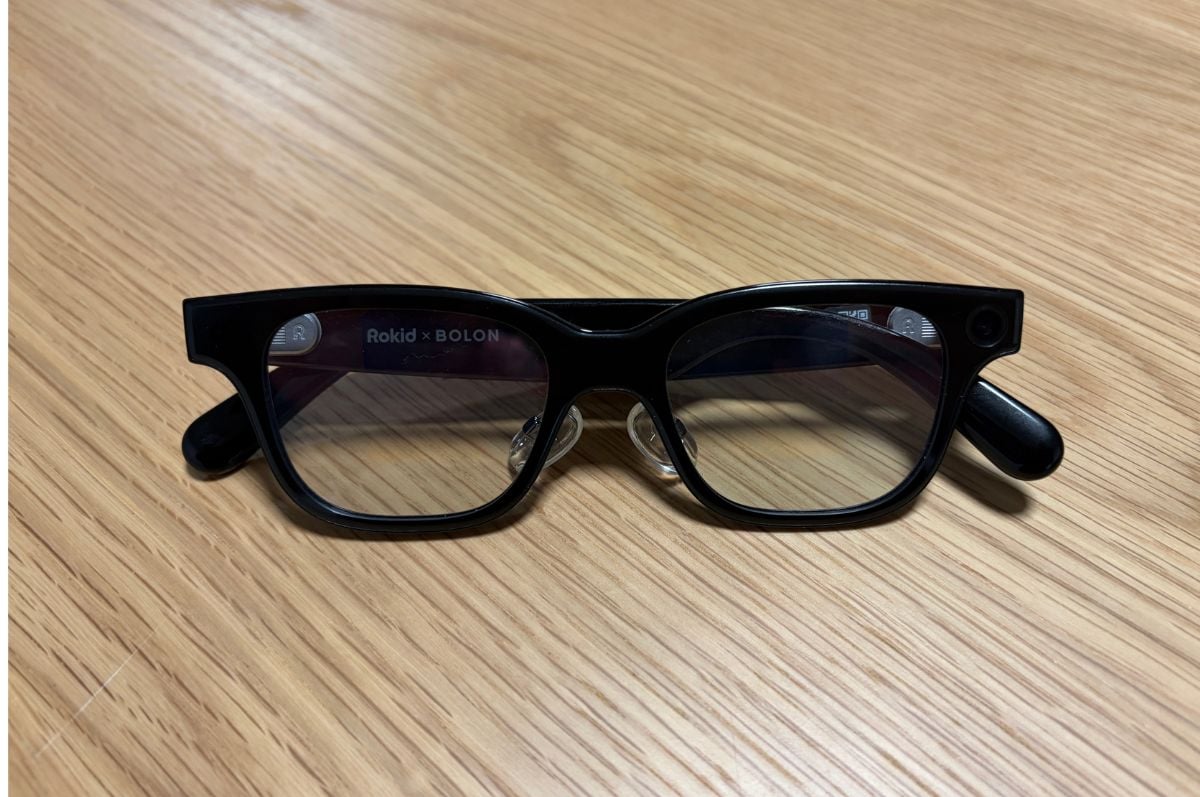
- Lightweight, comfortable to wear
- Practical AI features
- Buggy at times, controls take time to learn
- Privacy concerns
Rokid’s eponymous smart glasses might just be a glimpse into a future of mobile that has not yet come to pass. With a monochrome green display à la Fallout’s Pip Boy, lightweight frame and wide array of on-board features, Rokid Glasses feel like something straight out of a sci-fi novel.
The dual MicroLEDs deliver a crisp image or heads-up display, with a wide range of settings to adjust the brightness to your comfort and at only 49 grams, the frames barely register any difference from my usual glasses. While Rokid is confident smart glasses will one day replace mobile phones, its products (and the entire product category) still have a ways to go before that’s a reality.
A big boon for Rokid Glasses where AI and AR are concerned is that the tools on offer are genuinely useful. Take, for example, the teleprompter, which lets you easily write a script (either importing it or writing into the app) you can then read off the autocue; the mileage may vary depending on your specific audience.
The glasses leverage a couple of different large language models, including Gemini and ChatGPT. But this also means the AI-powered experiences are really only as good as what they’re pulling from.
The live translation feature, while neat, is just as awkward an experience as when I tested the same feature on a Google Pixel, except rather than getting an audio output, it was visual from the glasses. It also means that rather than engaging with someone and reading their social cues while talking to them, you’re staring off into space reading the real-time translation. I don’t think any interpreters will be losing their jobs just yet.
Navigation via a heads-up display is neat, but again, just as pedestrians need to be mindful of being distracted looking down at their phones while walking around, it’s a little harder to keep an eye on your surroundings when there’s so much information overlaid.
In terms of usurping your phone, expectations for now remain lukewarm. At times the Rokid Glasses are quite buggy. New notification? Here are 15 more. In fairness, I hadn’t entirely dismissed them on my phone, but no one wants to see the same 15 notifications pop up on their face all day. You can change your notifications (some specifically for the glasses), but no one wants to spend the time getting so granular. And of course, the Rokid Glasses rely on your phone to work, which made it even more annoying that they'd occasionally disconnect entirely.
When the Rokid Glasses do work more as expected, it’s still certainly a different experience with notifications popping up in real time or working out how to properly navigate the apps. Other people can see when your focus is elsewhere on your phone, but you do look a bit strange muttering to yourself, finger to your temple.
With built-in speakers and the option to play music from your phone, the Rokid Glasses can be an effective-enough earphone replacement, although the people around you might beg to differ as the sound can just leak to your surroundings. At higher volumes, the audio does have a tinnier quality. You definitely aren’t going to purchase these as open-ear headphones.

For all the good things the Rokid Glasses bring, it's hard to talk about them without addressing the elephant in the room. There’s a growing social stigma around smart glasses, largely from a privacy point of view.
As much as there is a growing interest around technology (the cool factor is undeniable), there are reasonable questions around privacy and whether or not it's right to have people going about their day feeling like they're being discreetly surveilled.
The 12MP camera, while powering some of the AI features, can also take photos and videos. (Even here, there's an oversight in needing to manually import media from the glasses into the Rokid app.)
Like other brands, the Rokid Glasses do have some guardrails around this. The device's voice will say “Do not block the camera indicator light” if it's blocked. Deciding to test its patience, I deliberately held my finger against the light and within a few seconds video recording ceased altogether.
The indicator light is fairly bright indoors and with Rokid’s distinct green display it’s quite often easy to tell when they’re in use, but outdoors in bright sunlight the camera indicator is much more subtle and can easily be mistaken for a bit of glare reflecting off the polished frames.
Some will argue that everyone already carries around their smartphones and can already film everyone any time; this is a valid point and perhaps leads us to wider discussions around privacy in public life.
More broadly, if anything, these glasses made me even more aware of how digitised our lives are and how many distractions exist. It's one thing to use a device like Brick to limit my phone screen time, then add a whole new device - with notifications in front of my eyes - to the stack.
We've spent enough time with this product to piece together our thoughts, but not enough time to put it through our official testing process. We've got a good sense of what is good, what could be improved, and whether it is worth your money, but we're not assigning a score to this one.
Dylan Crismale
Digital Content Editor

Related Articles


