
Recently, a friend told me about an old man he spoke to at a bus stop briefly. My friend had arrived at his stop a few minutes early and, as he always does, he pulled out his phone and starting checking the news.
"If you'd told me 50 years ago, that one day people would carry around a box that could tell them about anything they wanted to know, I would have laughed at you". the old man said.
Sometimes it is difficult to look into the future and imagine what is coming next.
At the end of this week, Australians will shuffle into the polling booths and play their part towards choosing the country's governing party. Though it is not the only major issue for consideration, a part of this decision will be choosing which National Broadband Network (NBN) plan becomes reality.
This has been a major part of the political arm wrestle in the months leading up to this election, with the Labor party backing its existing plan to install a fibre optic cable connection into everyone' home and workplace, and the Coalition calling for cost savings by running a slower, cheaper copper connection from a hub in your suburb to your home.
As it goes with politicking, there is a lot of conflicting information about which solution would be best for Australia. There's a lot of debate about how much both networks will cost and whether 'we' can afford it, and there is also debate about whether or not we need a faster network at all.
I certainly don't have an argument relating to costs: you could give me all of the numbers and I'd still struggle to find a solution. But I do have an opinion on which NBN plan we need for the future.
According to the Australian Bureau of Statitics (ABS), Australians increased the amount of data they downloaded between 2011 and 2012 by 60-percent across wireless and fixed-line broadband connections.
Telecommunications analysts at Budde predict that internet usage will be at around 650 petabytes (PB) this year, but even this figure seems conservative.
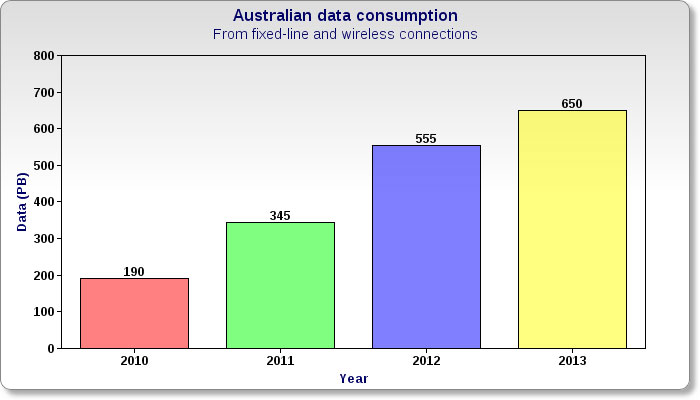
Australian internet usage is booming, and this is before we even know what new applications will come into existence between now and the next technological milestone. This is before we really start using high-data applications in health services and education. This is before telecommuting takes off in Australian businesses.
Of course, it not just that Australians are using the internet more, but that the internet is more data hungry that before. An analysis of the top 100 webpages revealed that these popular websites are all increasing in size, so that every time we visit we consume more data. Webpages increasingly have interactive elements and multimedia fragments and we are engaging with them more and more.
But this is an argument that goes beyond the trends of internet use in this decade, or the next. We might now be focused on the speed that web pages load and videos buffer, and current internet technologies are fine for these simple tasks, but building an NBN is about what we do with this technology next -- not about how fast we can do things now.
If we simply build a network that competes with the infrastructure that is already in place, then I agree with the naysayers -- it's a waste of money. What's the point of spending $30-billion so that iTunes movies download faster? The money needs to be spent on a network that can handle future capacity strain, that will create new opportunities in schools and businesses.
In 50 years, you'll probably be standing at the Hyperloop train terminal near your house watching teenagers use the internet in some way you'd have never thought of back in ol' 2013. But just because you can't imagine it now, doesn't mean we shouldn't build a network that supports it.
Joseph Hanlon

Related Articles


.png?w=160&h=160&usm=20&usmrad=0.8&fit=crop "Dodo pushes back the deadline for its latest NBN and mobile deals")


