
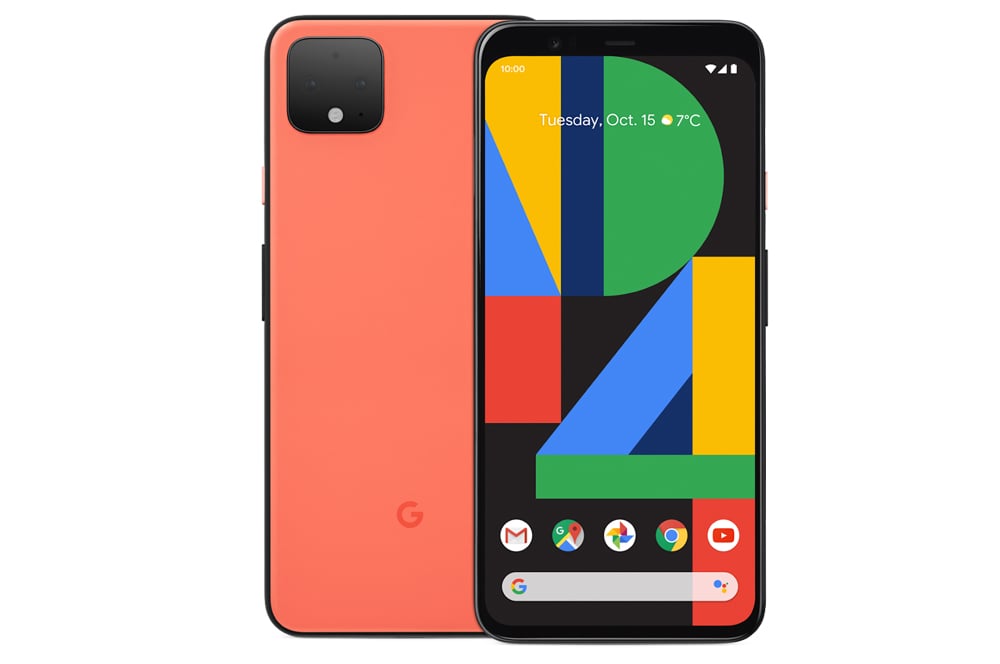
The most leaked smartphones ever are now official, with Google officially unveiling the Pixel 4 and Pixel 4 XL. In addition to the requisite spec bumps, the Pixel 4 family have four major new features: the first dual-rear facing camera on a Pixel device, a high refresh rate display, 3D facial recognition, and contactless gesture which let you interact with your Pixel 4 without touching it.
Before we get into the nitty gritty, here's the important stuff. The Pixel 4 starts at $1,049 for 64GB or $1,199 for 128GB. The Pixel 4 XL starts at $1,279 for 64GB or $1,429 for 128GB. That's actually cheaper than Pixel 3 and Pixel 3 XL pricing last year, bucking the more-expensive-every-year pricing trend we've seen recently. Thank god.
You'll be able to get the Pixel 4 and Pixel 4 XL outright at Google, JB Hi-Fi, Officeworks, and Harvey Norman, or on a plan through Telstra, Optus, and Vodafone.
Pixel 4 and Pixel 4 XL pre-orders start today ahead of an October 24 launch date. Here are the most popular Pixel 4 plans from our database:
And here are the most popular Pixel 4 XL plans:
The Pixel 4 and Pixel 4 XL both have two rear-facing cameras, making it the first dual camera smartphone in the Pixel family. Google has held firm with a 12MP primary lens, and paired it with a 16MP telephoto lens that can be used for 2x optical zoom and 8x hybrid zoom.
That's not quite as many lenses as we've seen from rivals like Huawei and OPPO who now have as many as four rear-facing cameras, but Google has a whole host of new software tricks that further extend the Pixel 4's camera capabilities. These include:
Live HDR+: The Pixel 4 can better approximate how your photo will look in the viewfinder before you take your shot - given how much smartphones rely on software to process a photo, there's typically a difference between what you see and what your final photo.
Dual Exposure Control: You're able to adjust both the brightness and shadows when composing a shot, rather than just brightness. Other smartphones can only adjust brightness.
Improved Portrait Mode: Thanks to the addition of a second lens, the Pixel 4's portrait mode will work on objects other than people, from further distances, and account for hair better.
Improved Night Sight: The Pixel 4's dedicated night photo mode can be used for astrophotography (photos where the stars are visible in a way that they aren't to the human eye) using exposures as long as four minutes. You'll need a tripod to do this, or another way to keep your Pixel 4 still for an extended period of time.
The Pixel 4 and Pixel 4 XL both feature what Google calls a "Smooth Display", or a 90Hz refresh rate screen. A conventional smartphone has a 60Hz refresh rate. This means the panel on a conventional smartphone can display 60 images per second, versus 90 images per second with Google's Smooth Display. This should make all motion on the Pixel look smoother - something that should be especially noticeable when it comes to animations and scrolling through apps.
An ever-growing number of cameras isn't the only trend Google is shying away from with the Pixel 4. Instead of using a notch or camera cut-out, the Pixel 4 and Pixel XL both have a rather chunky forehead bezel.
This gives the Pixel 4 more space for the a sophisticated 3D facial recognition setup a la the iPhone 11, rather than the 2D facial recognition as found on most Android smartphones. The setup combines a front facing camera with two infrared cameras, and a flood illuminator for more secure unlock technology. Google says face unlock works no matter what orientation you're holding your Pixel 4, even if it's upside down. As with Face ID on the iPhone, you'll be able to use the Pixel 4's face unlock for payments and app authentication.
What's even more interesting are Motion Sense Quick Gestures. Using a small radar called Soli, the Pixel 4 is able to detect small motions around the phone. For example, this lets you skip songs, snooze alarms, and silence phone calls by waving your hand. Google says these features are just the start, and will continue to evolve over time.
Notably, size and battery capacity are the only major differences between the Pixel 4 and Pixel 4 XL. The pair are identical in terms of design. For reference, the Pixel 3 XL and Pixel XL both had a different look to their respective smaller companion phones.
Here are the key specification for the Pixel 4 and Pixel 4 XL:
Key Specifications
| Pixel 4 | Pixel 4 XL | |
|---|---|---|
| Display | 5.7-inch 1080p+ | 6.3-inch 1440p+ |
| Processor | Snapdragon 855 | Snapdragon 855 |
| Storage | 64GB or 128GB | 64GB or 128GB |
| RAM | 6GB | 6GB |
| Rear-Facing Camera | 12MP + 16MP | 12MP + 16MP |
| Battery | 2,800mAh | 3,700mAh |
| Water-Resistance | IP68 | IP68 |
| Price | From $1,049 | From $1,279 |
Both the Pixel 4 and Pixel 4 XL are available in a choice of "Just Black", "Clearly White", and "Oh So Orange". The Oh So Orange Pixel 4 and Pixel 4 XL are only available in 64GB models.
To celebrate the launch of the Pixel 4 and Pixel 4 XL, there are few different offers available through different retailers. If you grab your Pixel through Telstra before January 13, you'll get a bonus Google Nest Hub. If you order with Vodafone before October 23, you'll get a bonus JBL Link 10 Wireless Portable Speaker. And if you go with Optus before December 31, you'll get a bonus Harman Kardon Citation One Speaker with Google Assistant.
In terms of outright offers, JB Hi-Fi, Harvey Norman, and Google will all throw in a $150 gift card for their respective stores to customers who order before October 23.
Alex Choros

Related Articles


