

Huawei invests 15% of its revenue back into research and development, and it shows. The Mate 20 Pro might be 2018's most complete phone; it's genuinely a "everything but the kitchen sink" kind of device. But the kitchen sink is a headphone jack. RIP little buddy.
The standard inclusions of top-tier processor and excellent display are backed up by stellar cameras and a battery life that's measured in days rather than hours. You get a bleeding-edge in-screen fingerprint reader, and proper 3D facial recognition. Oh, and it feels pretty nice too.
Read our full Huawei Mate 20 Pro review here!

Triple threat
Huawei got plenty of acclaim for the triple lens camera in the P20 Pro, and rightly so. It was a generational leap forward for smartphone photography. The Mate 20 Pro iterates on this triple lens setup, and while it isn't the same kind of step up we saw with the P20 Pro, it makes the camera a lot more versatile. The lens configuration now includes a 40MP primary lens, a 20MP ultra-wide angle lens, and an 8MP telephoto zoom lens. Most of the time, the Mate 20 Pro is using multiple lens in tandem (along with software and AI) to take better photos.
The P20 Pro's Night Mode makes a return, and is as impressive ever. Night mode uses exposure bracketing to get a more detailed image when shooting in lowlight environments. Essentially, the Mate 20 Pro will take multiple photos at different exposures over a short period of time and stitch them together to provide extra pop. Camera movement is accounted for using "AI stabilisation" which - on first impression - seems to have improved since the P20 Pro. Night mode images from the Mate 20 Pro tend to be sharper. Here's two photos examples:


You've got up to 5x hybrid zoom, which uses a combination of software and the telephoto lens to zoom beyond the cameras are physically capable of. You do lose out on a bit of detail - which becomes more apparent on a larger screen or when you zoom in on the photo - but it's a massive improvement over traditional digital zoom. Here's two photos at about 5x zoom:


There's also a "super macro" mode that lets you take extreme closeups. In order to achieve this, it seems like the Mate 20 Pro might be cropping an image and enhancing it, but the results look great nonetheless. And on Instagram, no one will be able to tell. Triggering super macro mode can be a bit tricky; it tends to pop up when you're very close to your subject, but it's inconsistent. A dedicated super macro mode button be useful. Here's a super macro shot, and a 100% crop.


The ultra-wide angle lens does what the name suggests, zooming out from your primary lens, rather than in. It does have a slight fisheye look to it, and isn't as good in lowlight, but it's a welcome addition to the toolkit. Here's a wide angle photo followed by the same image from the standard lens:


And here's a few more camera samples:








Baby got battery
Inside the Mate 20 Pro you'll find a sizeable 4,200mAh battery. I haven't been able to test it extensively yet, but in initial use, I've had over 60% left at the end of a full day. Most should be able to make it through two days on a single charge.
Some of this longevity can be chalked up to the Mate 20 Pro's aggressive battery management; Huawei has optimised the heck out of Android. Out of the box, the Mate 20 Pro will decrease its screen resolution in some situations to conserve battery. You'll also find that the software is merciless when it comes to terminating background processes, which can delay notifications from some apps. You can get around this by "locking" them in the multitasking menu, which is a must for anything messaging or email related.
Fortunately this is one of the few remaining quirks in Huawei's often divisive take on Android. Which it's not quite stock Android, Huawei isn't customising Android as much as it used to these days, and if you're after a clean Android feel, you can easily bring back options like the app drawer (which is disabled out of the box). There's plenty of preloaded apps out of the box, but thankfully most can be deleted.
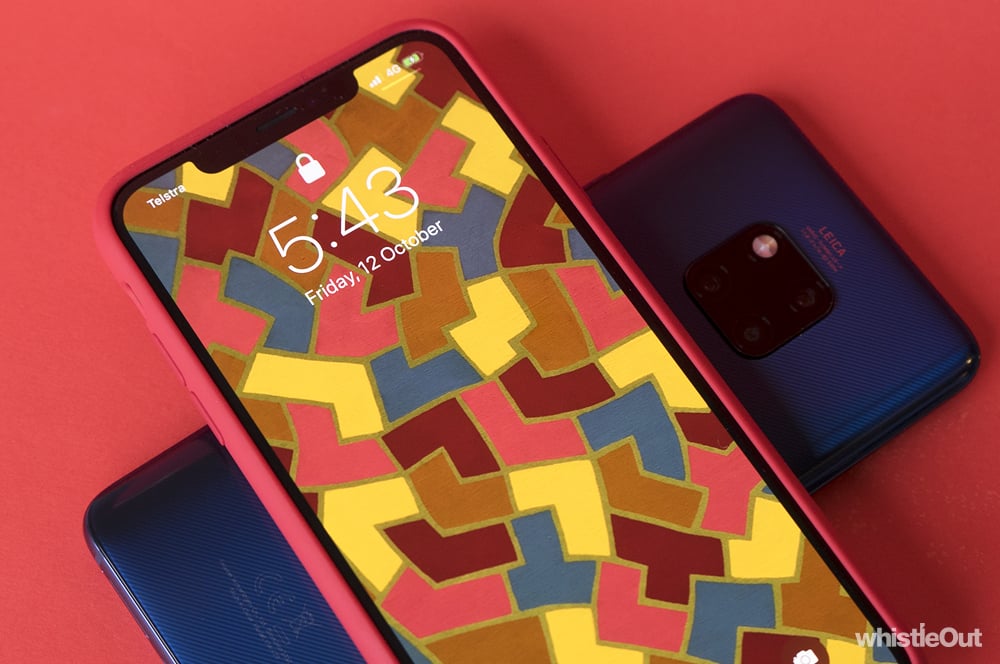
So what do you do with the Mate 20 Pro's massive battery? Charge your friends' phones, apparently. The Mate 20 Pro acts as a wireless charger, and can top up any Qi enabled device. This includes recent iPhones, the Pixel 3, and most Samsung flagships from the past couple of years. Reverse charging isn't exactly a new feature for Huawei - some past Mate smartphones have included it - but the move to wireless should make it a lot more useful, given you don't need to have any cables to take advantage of it. And hey, it's certainly a feature that lives up to the Mate name.
The Mate 20 Pro's in-screen fingerprint reader actually works really well; it's pretty much up to the same standard of a physical fingerprint. It might be a tiny bit slower, but how futuristic it feels makes up that for. Only a small part of the display recognises your fingerprint, so there's a bit of a learning curve in terms of hitting the right spot - especially if you're not looking at the display.
You've also got iPhone XS-style 3D facial recognition as an alternative - it doesn't just use the camera, but a whole array of sensors to detect your face - and it feels faster and more accurate than the in-screen fingerprint reader for the most part. That being said, the fingerprint reader is a great alternative if you're not into the whole scanning your face into your phone thing. And it is pretty damn cool.
Most Android phones have used microSD for expandable storage, but Huawei is bucking the trend and has introduced a new flash storage solution called NM Card. It's exactly the same size as a nano SIM, but it's very new. Like not yet available new. Like might not be available at launch new. 128GB out of the box storage is pretty good, but not being able to use existing microSD cards to augment the Mate 20 Pro's storage isn't ideal for more demanding users.

Head-to-head
While the Mate 20 Pro might be the kind of phone that can do it all, there is of course the question of just how high a price tag Huawei can command. $1,599 is a big step up from the flagship beating prices we've come to expect from Huawei locally. It makes the Mate 20 Pro more expensive than all but one Samsung handset, and puts Huawei squarely in iPhone territory. This is the first time we've seen Huawei try and go head-to-head with its rivals in terms of price parity.
None of this is to say the Mate 20 Pro isn't worth $1,599 - there's plenty of cool tech that helps justify the price. It just drastically changes the thought process around buying one. Past Mate smartphones definitely sat in the "affordable premium" category, with the Mate 20 Pro, Huawei is purely going for premium.
What's the difference between the Huawei Mate 20 and Huawei Mate 20 Pro?
While the non-Pro Mate 20 shares a lot of DNA with the Mate 20 Pro, there's significant differences. While the Mate 20 Pro has an extra-tall curved display, the Mate 20 has a more traditional 16:9 screen with flat edges. You don't get 3D facial recognition on the Mate 20, but this does however mean its notch is much smaller than the Pro's.
The Mate 20 also has a three rear-facing camera configuration, but with a slightly different setup. You get the same 8MP telephoto lens, but the primary camera lens is 12MP, and the ultra-wide angle lens is 16MP. We haven't been able to test a standard Mate 20 yet, so we're not sure how much a difference this makes to camera quality.
One other notable difference is the Mate 20 still has a headphone jack.
Here's how the pair compare:
Key Specifications
| Mate 20 Pro | Mate 20 | |
|---|---|---|
| Display | 6.39-inch OLED 1440p+ | 6.53-inch LCD 1080p |
| Processor | Kirin 980 | Kirin 980 |
| Storage | 128GB | 128GB |
| RAM | 6GB | 6GB |
| Rear-Facing Camera | 40MP + 20MP + 8MP | 12MP + 16MP + 8MP |
| Authentication | 3D face unlock + in-screen fingerprint reader | Face unlock + rear-facing fingerprint reader |
| Battery | 4,200mAh + Wireless Charging | 4,000mAh |
| Water-Resistance | IP68 | N/A |
| Price | $1,599 | From $1,099 |
How much will the Huawei Mate 20 Pro cost?
The Huawei Mate 20 Pro will set you back $1,599 outright. Optus and Vodafone have yet to confirm contract pricing.
When will the Huawei Mate 20 Pro be available?
The Huawei Mate 20 Pro will be available from November 1, with pre-orders starting today. You'll find it outright at JB Hi-Fi, Harvey Norman, Kogan, and MobileCiti. If you'd prefer it on a plan, Vodafone and Optus will both be ranging it.
Customers who pre-order through Vodafone, Optus, or JB Hi-Fi will get a bonus wireless charger and a pair of Freebuds.
WhistleOut travelled to London for the launch of the Mate 20 and Mate 20 Pro as a guest of Huawei.
Alex Choros

Related Articles


