

Smartphones are getting smarter in 2018, with flagships like the Samsung Galaxy Note9 and iPhone X incorporating artificial intelligence into photography, Face ID and more. Meanwhile, rival phone developer Huawei has just launched what they say is the most powerful and intelligent smartphone chipset yet.
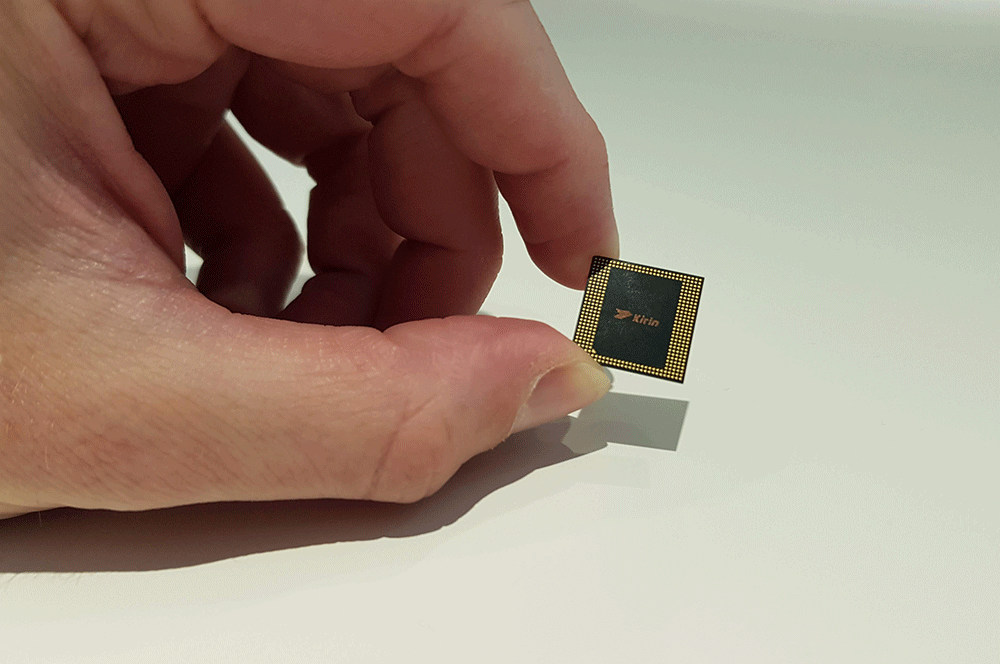
Known as the Kirin 980, the new chip is wafer thin and only one centimetre squared. But Huawei says it will be the brains behind a range of invisible improvements to its upcoming flagship phones, from the camera, to battery management, connectivity and more. Yesterday at IFA Berlin, we caught up with Arne Herklemann, Huawei's Head of Handset Portfolio and Planning in Europe, to talk about what it will be like to use a phone with the new AI chip.
Invisible improvements to the camera, battery management and more
The big feature is, of course, the AI camera capabilities. Huawei's AI cameras have actually been around for a little while now. At WhistleOut, we've already played with a few, in particular Huawei's P20 Pro, which is the undisputed best smartphone camera on the market right now (with an award from TIPA to prove it). According to Herkelmann, the AI on that phone is what helped the camera to achieve its award-winning status.
The P20 Pro is powered by Huawei's AI chipset from last year, the Kirin 970. If the promises of the Kirin 980 hold true, upcoming phones like the Huawei Mate 20 should be able to produce even more stunning photography.
Herkelmann says the Kirin 980 AI can compensate for bad lighting, zooming issues and can even distinguish between different types of food. It can recognise spaghetti or stir fry, for example, and then tune the colours in the photo to produce the best shot.
That's part of a feature set called scene recognition, something that is already present on Huawei's AI cameras, but that we expect to see improve with the new chip. But because features like scene recognition are automatic and hopefully seamless, a lot of the work the AI ends up doing on your photos is invisible. "What you see as a user is just great pictures."
And Herkelmann says that's not the only work the AI does that tends not to get noticed. On Huawei's upcoming flaghsip phones, the Kirin 980 chipset will perform resource management for longer battery life, audio management tasks like cancelling background chatter if you're making a call in a noisy place, and connectivity management to improve your mobile signal in certain situations. "So if you're on a high speed train, for example, and you're experiencing lots of changes and problems with the network, we can use AI to reconstruct and follow the signal better."
Algorithms at AI school
So how does an AI chip learn to do things like take better photos? Herkelmann told us to "think about it like a kid at school."
This conjured a lot of images of chipsets with backpacks and flap caps. But "AI school" sounds a lot more rigorous than that. The algorithm is shown multiple millions of photos. "You say, 'this is a cat', 'this is a cat' and you repeat, repeat and the AI starts to learn and understand. And it learns from mistakes. If there is a mistake there is always direct feedback." (Like AI detention?)
"You have AIs training themselves. You have AIs that need assisted training. You have AIs challenging other AIs to get better. Once we have developed a mathematical model, we can place it into the phone."
So what's next for AIs in phones?
This, according to Herkelmann, is "a big question". The sky is the limit, seemed to be the message, with more and more app developers working to optimise their programs and take advantage of new AI capabilities.
But one thing Herkelmann does expect to appear in AI photography in the future is photo editing skills like object removal. "Imagine you take a photo of the Eiffel Tower and then afterwards you notice there's a cab in front of it. You could just touch the cab and make it disappear."
These kinds of photo editing features are already available on apps and programs like Photoshop, for example. But Herkelmann imagines AI can make the process more accessible and seamless.
How do you get an AI phone?
There are already a range of Huawei smartphones on the market with AI capabilities from the mid-range Nova 3i retailing at $599 to the high-end and award-winning P20 Pro which you can pick up for $1,099 (hey, that's cheaper than the Galaxy S9 and the iPhone X).
Huawei's Mate 20 will be the first phone to use the new Kirin 980 chipset and will be unveiled on October 16. No information yet on Australian pricing but the Mate series has historically come in under $1,000. Wait for our review to see if the new chipset lives up to the hype.
Of course, Huawei is by no means the only manufacturer making phones with AI. The Samsung Note9 and LG G7 ThinQ, for example, both just launched with AI cameras advertised. A Note9 will set you back $1,499, while the G7 ThinQ costs less at $1,099.
Jacqui Dent travelled to IFA Berlin with travel and accommodation costs contributed by Huawei.
Jacqui Dent
Editorial Strategist

Related Articles


