

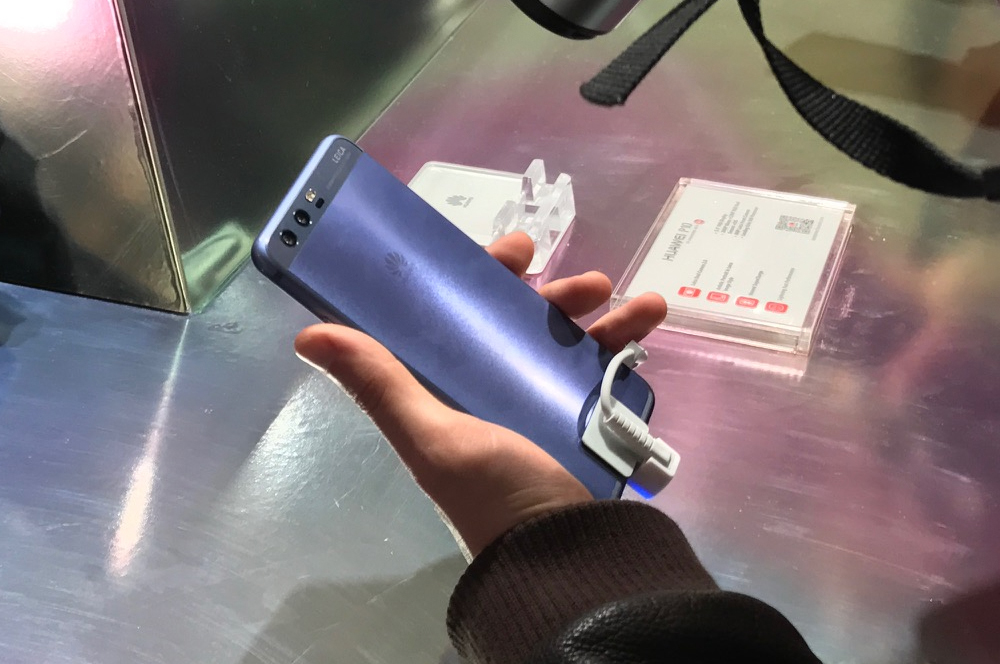
Huawei today unveiled its latest flagship smartphones, the 5.1-inch P10 and 5.5-inch P10 Plus. Succeeding last year's P9, the two devices are quite similar in terms of design, with a slightly curvier body and a front-facing fingerprint reader standing out as the two main aesthetic changes.
Once again, the P10 family's callout feature is dual rear-facing cameras, co-engineered with Leica. The configuration is made up of a 12MP colour sensor and a 20MP monochrome sensor, both with an aperture of f/1.8 on the P10 Plus and f/2.2 on the on the P10.
Since the second camera only shoots in black and white, Huawei says it can take it far more light information than a conventional camera, which in turn improves low-light performance and contrast. As with the iPhone 7 Plus, the P10 family's dual-camera setup can also be used to simulate bokeh when shooting either in colour or monochrome (the soft, out of focus areas typically produced by DSLRs when shooting at wide apertures). The P10 family also goes one step further than last year's model with a dedicated portraiture mode that uses the two cameras to 3D map a face and soften the background.
Leica branding has also been expanded to the P10's front-facing camera, with the company touting a wider aperture of f/1.9, doubled brightness, and extra dynamic range. The front-facing camera is backed up my some software smarts; Huawei says it can automatically change to a wider angle if it detects multiple people in your selfie.
Other new features include a stronger Gorilla Glass 5 display and water-resistance. However, Huawei didn't clarify to what level the devices are water-resistant to.
The devices are also the first 4.5G smartphones, allowing them to theoretically reach gigabit speeds on specific networks. Even in non-4.5G areas, Huawei says the new modem should increase data speeds and reduce dropped calls in weak signal areas.

The P10 family almost represents a bit of a fashion play, with Huawei Consumer CEO Richard Yu saying "we want to bring you the new cosmopolitan lifestyle, art with technology". In line with this, the P10 and P10 Plus will come in a wide range of colours and finishes.
Huawei says one of these - a golden Hyper Diamond-Cut - is a new type of finish that despite creating a super reflective surface, won't scratch, won't pick-up fingerprints, and isn't slippery. If you want another premium option, the devices will also come in a glossy white ceramic glass.
The P10 phones will be available in more traditional smartphone colours - graphite black, rose gold, mystic silver, and prestige gold - with a sandblasted matte finish. In partnership with the Pantone Color Institute, Huawei is also introducing two less mainstream smartphone colours: "Greenery" and "Dazzling Blue".
Key specifications for the P10 include a 5.1-inch 1080p display, a Kirin 960 processor, 4GB of RAM, 64GB of expandable storage, a customised version of Android based on Nougat, and a 3,200mAh battery .
Key specifications for the P10 Plus include a 5.5-inch Quad HD display, a Kirin 960 processor, 4GB or 6GB of RAM, 64GB or 128GB of expandable storage, a customised version of Android based on Nougat, and a 3,750mAh battery.
Neither phone supports Google Daydream or Google Assistant.
International availability kicks off from March, with the P10 starting at €649, and the P10 Plus from €699. Australia is scheduled to be a first wave market, with the phoness arriving in May or June. Local pricing has yet to be confirmed.
Alex Choros

Related Articles


Related Topics
Huawei Mobile World Congress smartphone AndroidPopular Topics
Android smartphone iPhone Apple Samsung Telstra Optus Vodafone Deals Oppo


