

Samsung today confirmed that two separate battery issues were the reason hundreds of its Galaxy Note 7 smartphones caught fire.
Based on an investigation of over 200,000 Note 7 devices and 30,000 batteries, Samsung was able to pinpoint specific flaws in each of the two batteries it used before the company was forced to kill off the critically acclaimed handset at the end of last year.
With the first iteration of the Galaxy Note 7, the battery had a design flaw in the upper right corner that could cause a short circuit. Samsung says an incorrectly positioned negative electrode also contributed to the Note 7's problems.
Different battery issues affected the "safe" replacement devices that Samsung distributed after the initial recall. These included poor welding, and in some cases, missing insulation tape. While these replacement batteries were initially deemed safe, the haste in which Samsung tried to churn out new devices introduced another defect.
Samsung's testing also that found that while the high capacity 3,500mAh battery didn't cause flaws, it did exacerbate problems when they occurred.
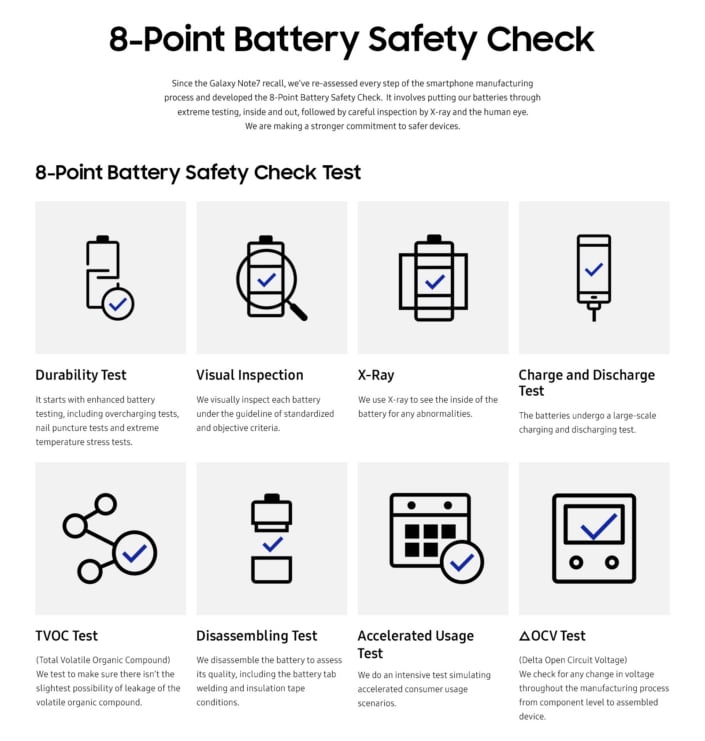
In order to prevent a repeat of this situation, Samsung says it's implementing a new eight-point safety check for batteries. As part of this process, Samsung says it will run durability tests, visual inspection, x-ray tests, disassembling tests, delta OCT tests, charge and discharge tests, TVOC tests, and accelerated usage tests.
"We hope that this case will be an opportunity to improve the safety of lithium-ion batteries for the whole industry," said Samsung's Mobile Communications Business president, DJ Koh
Samsung is expected to announce its next flagship smartphone, the Galaxy S8, in the coming months.
Alex Choros

Related Articles


