

Huawei (pronounced hwah-way) has announced the launch of its new flagship in Australia – for just $549. The Huawei Ascend P7 boasts mostly high-end specs and an impressively thin design with a tiny 6.5mm profile. Apart from the affordable price, its most stand-out feature is the 8MP front-facing camera, which should deliver selfies worthy of any Facebook or Instagram feed.
Bang for buck
In terms of what you pay for what you get, the Huawei Ascend P7 looks to be modelled in the Motorola Moto X mindset. That is, an almost top-tier phone for a drastically more-affordable price.
Where the Moto X sacrificed in screen resolution, the Ascend P7 still rocks a 5 inch 1080p display. Instead, Huawei has taken a different tact and opted to trim-down the CPU, going with a lower-powered quad-core 1.8GHz, rather than the beefy quad2.5GHz models we’re seeing hit shelves recently.
This decision sounds like a good one. Often phone CPUs are somewhat overpowered compared to what they need for day-to-day operations. The P7 should hopefully still provide a smooth user experience thanks to its 2GB of RAM, which is the same amount as found in the Samsung Galaxy S5.
There’s 16GB of on-board storage, but unfortunately no mention of a microSD slot for expanding that any further. The battery is an appreciably-large (especially considering the thin profile) 2500mAh and the whole thing comes running Android 4.4.2 out of the box.
Camera Craziness
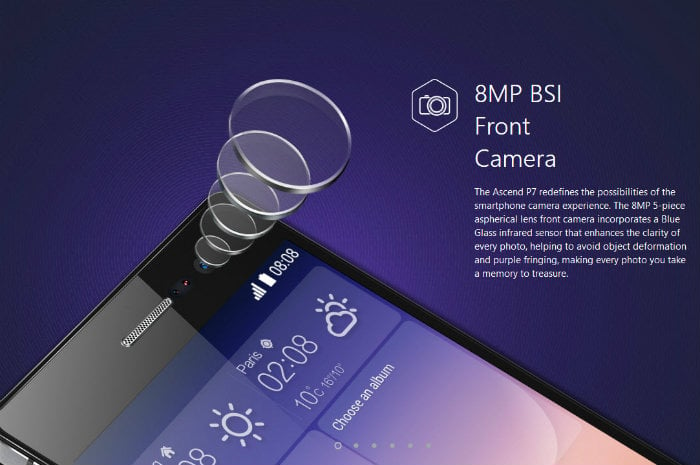
We’ve already mentioned the 8MP front-facing Selfie camera. It sounds like madness, but clever madness. After all, front-facing cameras have been a hot topic this year. The HTC One (M8) even had a 5MP one, which delivered great photos. All flagship devices, even the ones with low-res shooters, have moved to providing full wide-angle Selfie shots, which is great because now you can actually fit background images in to the frame, instead of just your face and a few hashtags for context.
One thing that has us scratching our heads is that the front-facing camera can take panoramic shots. How exactly this would work is puzzling. Generally the panoramic method is to start taking photos and swivel to the right on the heel of your foot, arms locked. However, this could be problematic if you’re in the middle of the frame and subsequently in every shot. Hopefully Huawei has developed some funky imaging software here to negate the problem, otherwise we can’t really see how that would work.
The rear camera is still the business-end, weighing in with a 13MP shooter. Huawei claims that both it and the front-facing cam will provide great low-light photos thanks to some infra-red sensing tech that has been built-in. This kind of thing is always impossible to judge until it gets in to the hands of regular users, so we’ll hold off on getting excited just yet.
All in all the Huawei Ascend P7 sounds like a great phone for the price. Its lower-specced CPU should still be fast enough to handle daily operations and the rest of its hardware, especially the selfie cam and 1080p display, should prove attractive to users.
Of course, Huawei is still working on building a reputation Down Under, but judging by how the P7 looks on paper it has a decent chance of carving itself out some of that sweet market share.
Alex Angove-Plumb
Digital Content Editor

Related Articles


