

After many leaks and countless official teases, Google has finally revealed the Pixel 8 and Pixel 8 Pro. Despite the plethora of rumours, pricing was one of the big unknowns, and like everything else, Google's new flagship phones have gotten more expensive.
The standard Pixel 8 starts at $1,199 for a 128GB model, while the Pixel 8 Pro starts at $1,699. This makes the Pixel family more expensive than its ever been. The Pixel 7 and Pixel 7 Pro launched at $999 and $1,299, respectively, and the most expensive Pixel we've seen to date was the Pixel 2 XL, which started at $1,399.
Of course, Google is far from the only manufacturer to have increased flagship phone prices this year. Both the Galaxy S23 and iPhone 15 launched at $100 more than their predecessors did.
Before we get into the full details, both the Pixel 8 and Pixel 8 Pro are available for pre-order from today ahead of an October 12 launch. Naturally, there are a handful of pre-order bonuses.
If you nab either phone from Telstra or Optus, you'll get a bonus Pixel Watch 2. Specifically, the 4G-enabled version. If you pre-order from Vodafone, you'll get a $150 Google Store voucher with the Pixel 8, or a $250 Google Store voucher with the Pixel 8 Pro. Vodafone is also offering $250 bonus trade-in credit.
Camera upgrades are arguably the standout feature of the Pixel 8 family. Some of these are hardware upgrades, while others are AI-driven software enhancements.
To start, both the Pixel 8 and Pixel 8 Pro benefit from a new 50MP primary lens with a faster aperture than last year's models. This should mean less motion blur and better low-light photography.
The Pixel 8 still has just two rear cameras, pairing the 50MP primary lens with a 12MP ultra-wide lens. The ultra-wide lens is capable of a macro mode this year.
Meanwhile, the Pixel 8 Pro now has a much higher resolution 48MP ultra-wide lens. This is joined by a new 48MP 5x telephoto lens. That's the same resolution and optical zoom as last year, but the lens is much faster this time around. This is especially pertinent with long-range zoom, as small hand movements can contribute large amounts of blur.
These hardware changes are joined by some new software tricks. These are as follows:
- Best Take: If you're taking group photos you'll be able to swap individual faces in and out from other takes. It's a customised way to combine multiple photos into one shot
- Magic Editor: This builds on Magic Eraser, and lets you move subjects around your image, remove background objects, and even change the sky. This will be coming later this year
- Video Boost: Video Boost uploads your videos to Google's data centres, and will eventually send back a better version of whatever you shot. In an example shared with media, this effectively enabled night mode for video, making low-light footage a lot brighter.
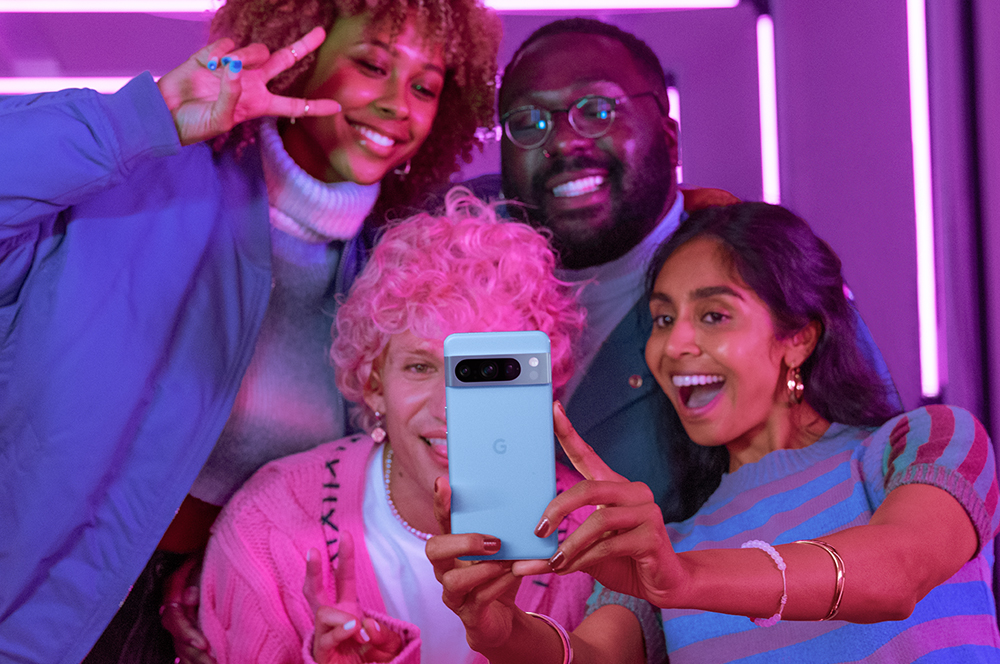
The other standout improvement is a greatly extended software life cycle. The Pixel 8 and Pixel 8 Pro will both receive seven years of operating system updates and seven years of security updates. That's a big increase over the three years of operating system updates and seven years of security Google promised on past models. It's also an industry-leading promise. Apple has historically had the best track record with post-purchase support, with phones receiving at least five major operating system upgrades.
The Pixel 8 family continues to be powered by an in-house Google processor - the third-generation Tensor. While Google says the Tensor G3 is faster than last year's chip, it hasn't talked about pure performance. Instead, a Google spokesperson told us the Tensor G3 is focused on efficiency and on facilitating helpful experiences (such as the new AI camera features) rather than "chasing speeds and feeds that don't affect the user".
Other new similar features include Audio Eraser, which can remove unwanted background noise from videos, and the ability to ask Google Assistant to read content out loud and translate it at the same time.
In terms of the phones themselves, the Pixel 8 is a little smaller once again, with Google cutting it down from 6.3-inch to 6.2-inch. The refresh rate has been upped to 120Hz, just like the Pixel 8 Pro. The Pixel 8 Pro holds firm at 6.8-inch, but the display is flat instead of curved this year.
Like the Pixel 8, the Pixel 8 Pro has a 120Hz refresh rate. This refresh rate is dynamic, however. Rather than being stuck at 120Hz constantly, the Pixel 8 Pro can adjust its refresh rate on the fly, going as low as 1Hz if you're not using the phone. This helps conserve battery life.
In terms of battery, Google says both phones can last "beyond 24 hours". There's also an extreme battery save mode said to last up to 72 hours, but disables functionality like 5G. This is unchanged from last year's models.
Once again, the Pixel 8 Pro supports mmWave, making it the third phone to do so in Australia. mmWave is a faster form of 5G that operates on higher frequencies. This allows for faster download speeds - over 3Gbps - but at the cost of range. The Pixel 6 Pro and Pixel 7 Pro are the only other phones to have launched with this functionality. mmWave 5G coverage is still scarce, however, and largely limited to capital city CBDs.
One interesting new feature in the Pixel 8 Pro that you won't find anywhere else is a thermometer. This can be used to get the temperature of objects, and Google is seeking FDA approval to let users take their temperature and log it in the Fitbit app.
Here's a complete rundown of how the Pixel 8 and Pixel 8 Pro compare in terms of hardware:
| Pixel 8 | Pixel 8 Pro | |
|---|---|---|
| Display | 6.2-inch Actua | 6.7-inch Super Actua |
| Resolution | 1080p+ | Quad HD |
| Refresh Rate | 120Hz | 120Hz |
| Rear Cameras | 50MP + 12MP | 50MP + 48MP + 48MP |
| Front Camera | 10.5MP | 10.5MP |
| Processor | Tensor G3 | Tensor G3 |
| Storage | 128GB - 256GB | 128GB - 512GB |
| Water-Resistance | IP68 | IP68 |
| Battery | 4,575mAh | 5,050mAh |
| RAM | 8GB | 12GB |
| 5G | Sub 6 | Sub 6 + mmWave |
| Protection | Gorilla Glass Victus | Gorilla Glass Victus 2 |
| Thermometer | No | Yes |
| Price | From $1,199 | From $1,699 |
The Pixel 8 is available in a choice of Obsidian (black), Hazel (a deep grey-green), and Rose (pink). Meanwhile, the Pixel 8 Pro is available in Obsidian (black), Porcelain (white), and Bay (blue).
Complete pricing for the new phones is as follows:
| Phone | RRP |
|---|---|
| Pixel 8 (128GB) | $1,199 |
| Pixel 8 (256GB) | $1,299 |
| Pixel 8 Pro (128GB) | $1,699 |
| Pixel 8 Pro (256GB) | $1,799 |
| Pixel 8 Pro (512GB) | $1,999 |
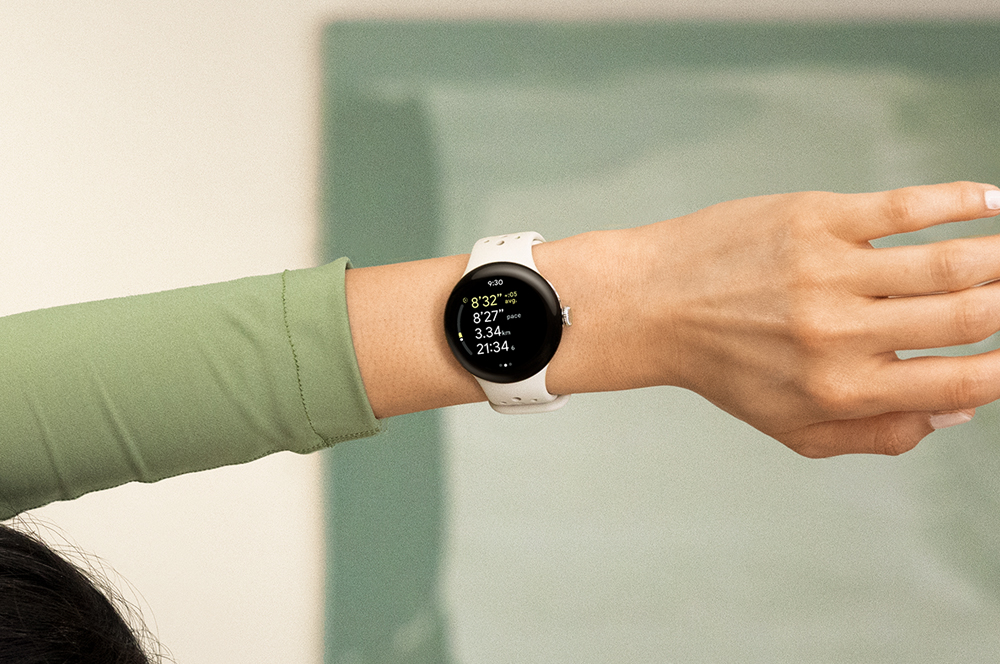
Google also announced its second take on a smartwatch, the Pixel Watch 2. The second-generation model is almost identical to the first, but the hardware is a little more polished. The buttons are more integrated into the design, and the digital crown is tucked in slightly.
Battery life is a key improvement. While the original Pixel Watch didn't have much longevity, Google says the Pixel Watch 2 will get a full 24 hours per charge with the always-on display switched on. Fast charging has also been improved, with a 30-minute top-up taking you from flat to 50%.
Other key enhancements include a more accurate heart rate sensor, fall detection, and emergency SOS. There's also a new Safety Check feature that allows you to schedule a timer for situations where you might want to let a friend or family know where you are. When the timer expires, you'll be asked to say you're okay. If not, the Pixel Watch 2 will start sharing your location with your contacts, or can contact emergency services.
The Pixel Watch 2 is available to pre-order from today, ahead of an October 12 release. It will set you back $549 for a WiFi-only version, or $649 for a 4G-enabled model. No matter which you pick, you'll get six months of Fitbit Premium for free - whether you're a new user or have used the service before.
Alex Choros

Related Articles


