

After years of rumours, Apple today unveiled the Vision Pro, its first take on an extended reality headset. The Vision Pro feels like a typical Apple product in that it's far from the first in the category, but it attempts to solve the major issues. In the case of the extended reality space, motion sickness, for example.
But first, let's look at what exactly the Vision Pro is. While the Vision Pro is capable of virtual reality, the emphasis is primarily on augmented reality - blurring the digital and physical worlds.
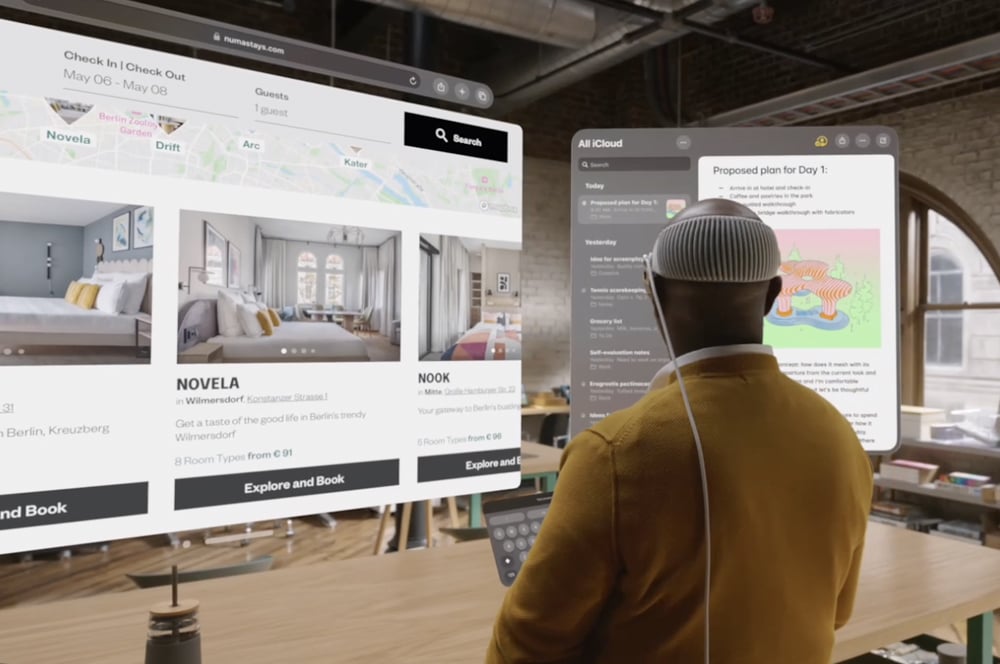
When wearing the Vision Pro, users will see apps fill the space around them - they'll even cast shadows. Displays can be made any size you want, effectively your environment an "infinite canvas" in the words of Apple. The Vision Pro can even be used as an external display for a Mac, giving you a giant virtual monitor that can run alongside other Vision Pro apps.
Users will primarily interact with Vision Pro with their eyes, hands, and voice. The headset features eye-tracking functionality which is used to navigate around the interface, but hand gestures are used for tasks like scrolling. There'll be a virtual keyboard you can use for typing, but you can also pair Vision Pro with Bluetooth keyboards, trackpads, and game controllers.
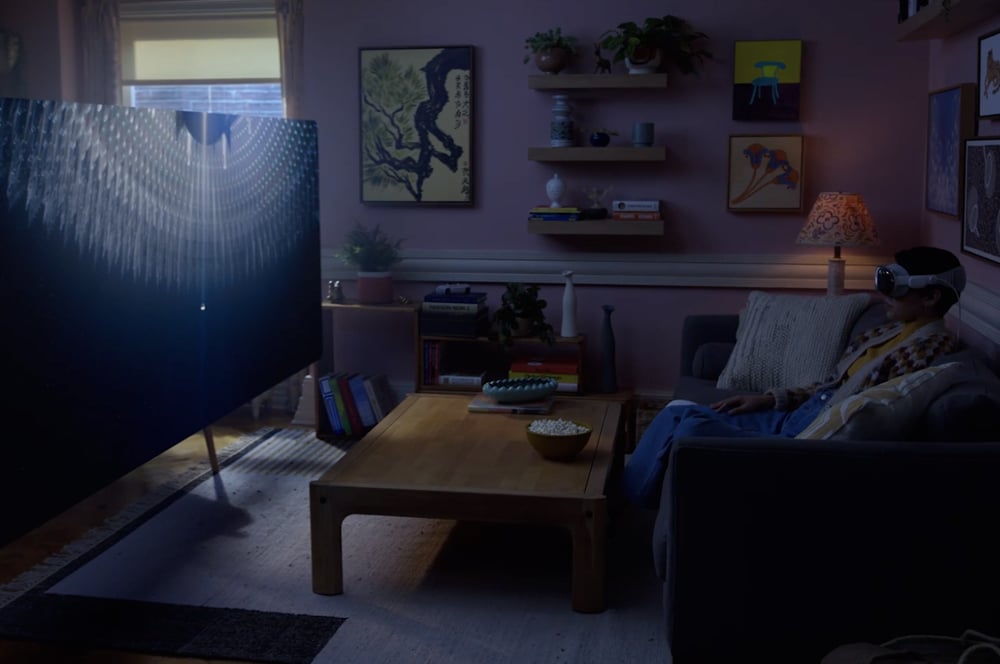
While there's a productivity element of the Vision Pro, Apple is also pitching it as an entertainment platform. It will be able to render giant screens for watching TV or movies, while either dimming the real world or replacing it with a vista.
The Vision Pro will naturally work with AirPods, but is also designed to be used without earbuds. It has what Apple calls "dual driver audio pods" that trick your brain into thinking the sound it makes is coming from the environment around you. It can even analyse your environment to make the sounds match your room.
As aforementioned, Apple has seemingly tried to address a number of limitations with current extended reality headsets. To start, the displays in the Vision Pro both run at a resolution higher than 4K, which should be high enough resolution to eliminate the barn door effect - where you can see the gaps between pixels when using a headset. Apple says even fine text will look ultra-sharp when you're reading it on the headset.
In an attempt to eliminate motion sickness that can be caused by such devices, the Vision Pro has a dedicated process for processing the input from its 12 cameras, five sensors, and six microphones to reduce lag. Apple says new images are beamed to the eyes within 12 milliseconds, which is eight times faster than the blink of an eye.
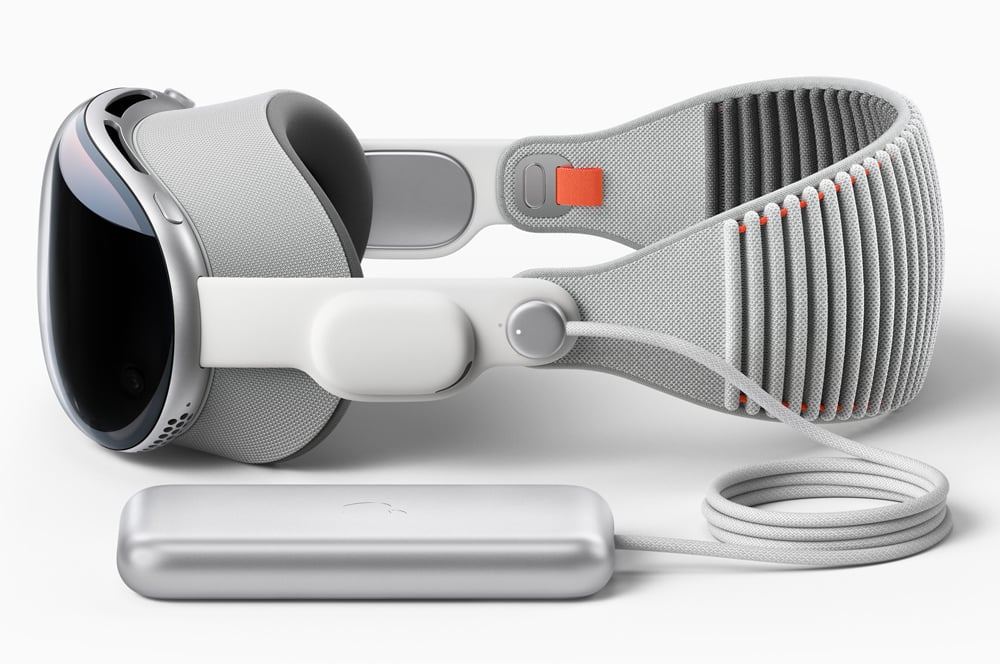
To reduce headset weight, Apple has used an external battery pack that gives the Vision Pro up to two hours per charge. The Vision Pro can also be used plugged into mains power. Apple says the Vision Pro is almost silent and barely emits heat thanks to the M2 processor it's powered by.
The Vision Pro design is entirely modular with replaceable headbands and light seals to ensure comfort for different head types. Customers will be able to get fittings at Apple Stores. Optional ZEISS Optical Inserts will be available for those who normally wear glasses, but these will cost extra.
On the front, the Vision Pro has an external display that will render the user's eyes. This is so that others in the room still know where the Vision Pro wearer is looking. The Vision Pro display will also highlight if the wearer is in a virtual reality experience blocking out the real world, but anyone approaching them will still be filtered into their field of view.
Vision Pro is powered by visionOS, a new operating system based on the core used for iOS. Apple says Vision Pro will be compatible with hundreds of iPhone and iPad apps at launch. That's a big advantage when launching an entirely new computing platform. In addition to Apple apps, Word, Excel, Microsoft Teams, Zoom, Adobe Lightroom, and Disney Plus are all confirmed for Vision Pro.
Other Vision Pro features include the ability to make a virtual avatar for video calls and iris authentication for unlocking the device and payments. The Vision Pro can also be used as a 3D camera for capturing more immersive content with Spatial Audio.
Of course, the proof will be in the pudding, and the pudding is still quite a while away. Vision Pro will be available at the start of next year in the United States, retailing for USD$3,499. At current exchange rates, that's almost $5,300. Local pricing and availability have yet to be confirmed.
Alex Choros

Related Articles


