
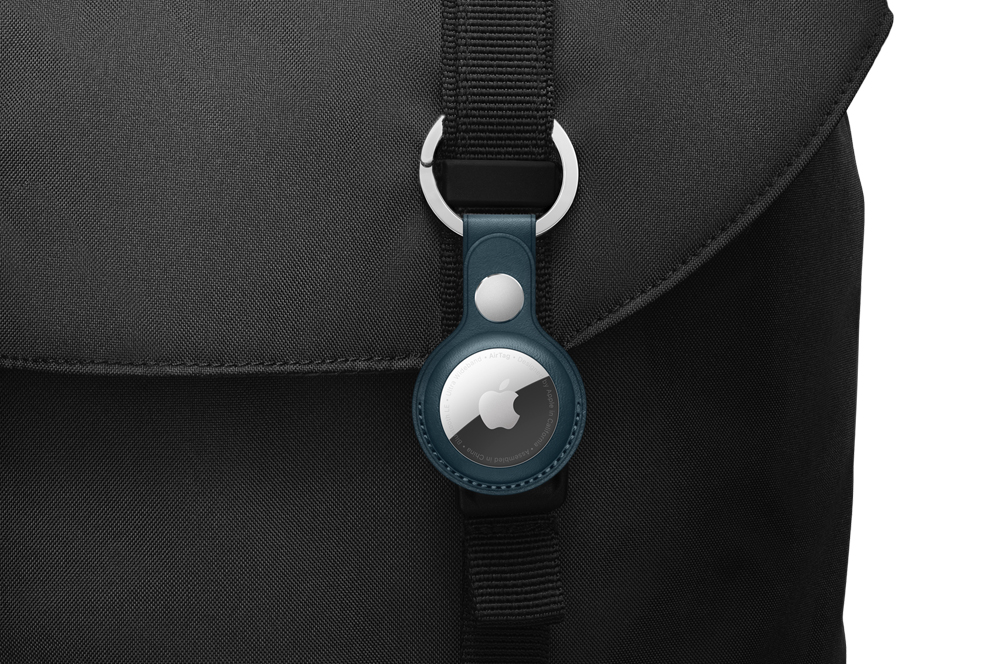
Apple today announced AirTag, a small digital tracker designed to stop you from losing important possessions. Each AirTag weighs about 11 grams, is just over an inch in size, and is designed to attach to items like your wallet, bag, keys, or suitcase.
Once you set up an AirTag and attached it to a device, you can see its location using the "Find My" menu on your iPhone, iPad, or Mac. Each AirTag has an integrated speaker that you can use to make finding an object easier, and naturally, they also integrated with Siri. Asking Siri to find your wallet will cause the respective AirTag to chime, for example.
If you've left something out of range out of your iPhone, AirTags emit an anonymous Bluetooth signal that will be picked up by other iPhones, iPads, and Macs in the area. These then send the location of your AirTag to the internet, and keeps you updated as to its whereabouts. If you put an AirTag into Lost Mode, you'll get a notification as soon as it is detected by another device. And if someone else finds your AirTag, they can tap it with any NFC-capable smartphone to get your contact info.
If you've got an iPhone 11 or iPhone 12 and your AirTag is nearby, you'll get more precise directions for finding it. "Six metres to your right," for example.
AirTags are IP67 water-resistant, and have a replaceable battery said to last up to a year.
A single AirTag will set you back $45, while a four pack goes for $149. That brings each AirTag down to $37.25. For comparison, Tile - the AirTag's most established competitor - starts at $24.99 for the standard model locally, and $36.99 for the Pro model. AirTag pre-orders start at 10pm on April 23 ahead of an April 30 release date.
Apple also has a range of AirTag accessories, including a leather key ring for $55, a leather loop for fastening your AirTag to your bag for $59, and a polyurethane loop for $45. Belkin already has its own range of AirTag holders starting at $19.95, while those feeling especially bougie can opt for Hermes accessories that start at $449.
Alex Choros

Related Articles


