
It's an age-old Australian fact — Telstra has the largest mobile network in the country. But what exactly does that mean for you, the customer? Describing network size based on the population covered, we know that Telstra's coverage is 99.7% of Australia.
In this guide, we'll take a look at Telstra's coverage and how it compares to Vodafone and Optus' mobile networks, the progress of its 5G rollout, and if its plans are right for you.
But first, here are the most popular SIM-only and prepaid plans available on the Telstra network, including Telstra for comparison:
|
Boost Mobile

$39 Prepaid
$39.00
Per 28 Day Renewal
|
|
Tangerine Telecom

30GB 5G Mobile SIM
$30.00/mth
Min. cost $15
|
|
Exetel

Plus One eSIM Plan
$40.00
Per 30 Day Renewal
|
|
Telstra

$54 Pre-Paid Mobile
$54.00
Per 28 Day Renewal
Link not supplied
|
|
Superloop

SuperSim Saver 4G Plan
$25.00
Per 30 Day Renewal
|
|
Belong

25GB Mobile Plan
$34.00/mth
Min. cost $34
Link not supplied
|
|
ALDI mobile

$28 Mobile Plan
$28.00
Per 30 Day Renewal
Link not supplied
|
|
Everyday Mobile

Pre-paid Mobile $25 Recharge
$25.00
Per 30 Day Renewal
Link not supplied
|
|
More

75GB 5G Mobile SIM
$46.00/mth
Min. cost $46
Link not supplied
|
|
EZEE Mobile

100GB Mobile SIM Plan
$45.00
Per 30 Day Renewal
Link not supplied
|

Telstra mobile network coverage
If you go to Telstra's website, you'll find its mobile network coverage map that allows you to search by Australian addresses to see where Telstra's mobile network coverage reaches. It also lets you compare its 4G and 5G coverage.
However, by using WhistleOut's interactive coverage checker tool, you can compare 5G coverage to 4G coverage around Australia from the Big Three telcos all at once. This helps you make a more informed decision about which mobile network you should choose. Simply tick the box of the type of connection you want to see. The map will show you what kind of coverage you have in your area. 5G coverage is highlighted using the darkest shade of purple, but unticking 4G can help make it clearer. Then select which provider you want to check out by selecting it from the drop-down menu below the map.
Keep in mind mobile network coverage works off population, it doesn't consider the actual geographic coverage. While population coverage is essential, this does however mean there are parts of Australia that even the Vodafone network can't reach. So even though its maps generally colour in whole suburbs, you shouldn't expect coverage to completely blanket the entire area shown.
Coverage maps are only approximate, only show outdoor coverage, and may be impacted by local conditions, such as buildings.
Covering a total of 99.7% of the Australian population, Telstra is undeniably the largest mobile network in the country which explains why it's synonymous with rural customers who may not get reception with any other provider.
Lucky individuals in select areas can also gain access to the provider's 5G network since all Telstra plans come with 5G access included. Telstra's 5G network coverage is 95% at last reporting.
In comparison, Optus and Vodafone mobile network coverage hold only 98.5% and 98.4% respectively.
With 98.5% of the Australian population covered, Optus is an ever-growing network on the heels of Telstra. Suitable for most of the country, especially those in city-centres, only those in rural and remote areas may miss out when compared to Telstra. Unlike Telstra, however, Optus' MVNOs are not split between two networks. Each Optus MVNO offers the exact same coverage as a regular Optus customer.
On the other hand, Vodafone covers 98.4% of the population thanks to a network-sharing deal with Optus. While that leaves it at the back of the pack, 98.4% still covers the vast majority of the country, making it suitable for pretty much everyone outside of rural and remote communities. Only marginally less than Optus, it too offers the exact same coverage through its MVNOs. Plus, thanks to the 30-day satisfaction guarantee, you can test out the Vodafone network to see if it's right for you. And if you're not happy with the coverage you can opt-out — no strings attached.
What about Telstra MVNOs?
Telstra is not the only option for gaining access to its near 100% mobile coverage. Many smaller providers can also offer you a plan on the Telstra network. In the industry, we call these providers Mobile Virtual Network Operators (MVNOs). Each MVNO is authorised to resell access to larger mobile networks like Telstra's. With fewer overheads and no network maintenance costs to contend with, MVNOs can offer basically the same plans as big brand telcos without charging big brand costs.
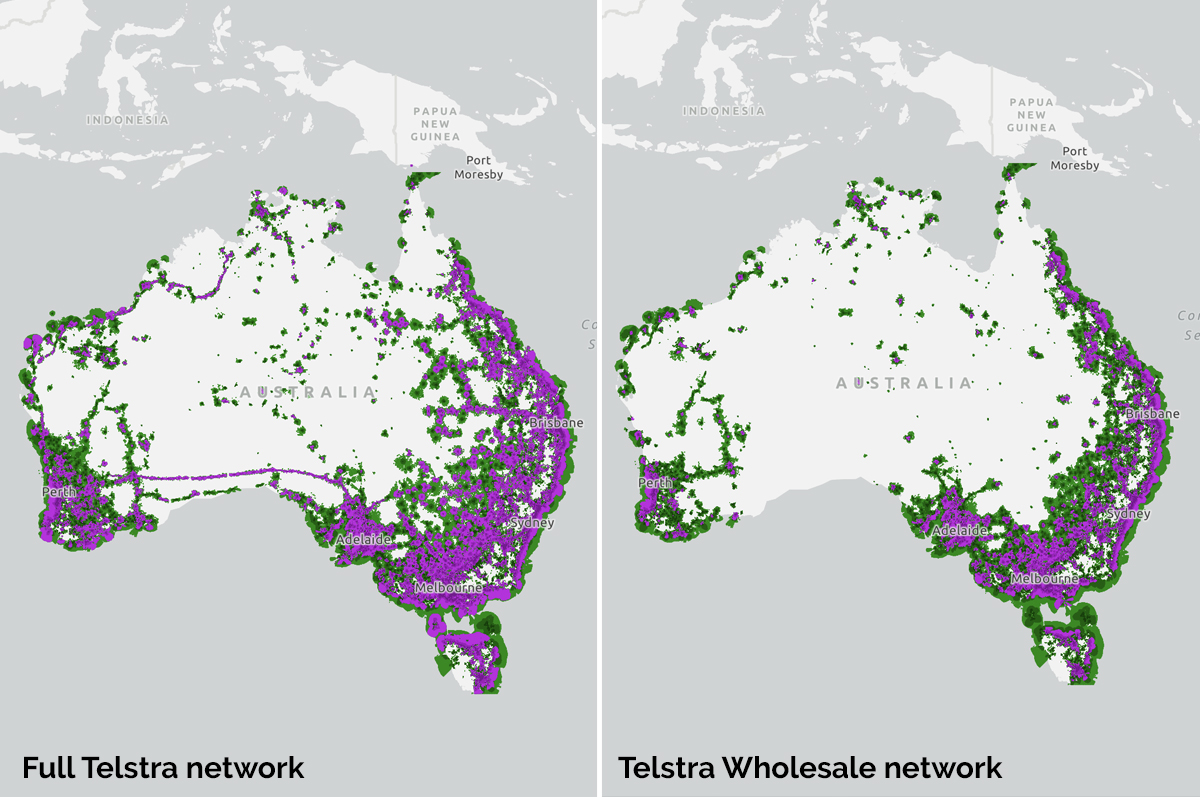
Sounds too good to be true, right? There is one technicality with Telstra MVNOs in that they do not offer access to the entire Telstra network. This is because of the way Telstra divides its mobile coverage. Split across two networks, Telstra's full network (99.7%) is offered to its customers while MVNOs use Telstra's wholesale network which reaches only 98.8% of the population. The only exception is Boost Mobile who has complete access to the Telstra mobile network.
So who are all of the MVNOs that sit under Telstra? Take a look at our list below:
At the time of writing, WhistleOut monitors 11 MVNOs that use the Telstra network. These are:
While less than one percentage point might not seem like a big deal, it will affect your coverage in some remote, regional, and rural areas. To illustrate this difference, here is a comparison between the regular Telstra network and the Telstra wholesale network:
Here are some of the cheapest plans (with at least 20GB of data) in our database offered by these Telstra MVNOs with a 28 to 31-day expiry:
|
Everyday Mobile
Pre-paid Mobile $25 Recharge
$25.00
Per 30 Day Renewal
Link not supplied
|
|
EZEE Mobile
29GB Mobile SIM Plan
$29.00
Per 30 Day Renewal
Link not supplied
|
|
Tangerine Telecom
30GB 5G Mobile SIM
$30.00/mth
Min. cost $15
|
|
More
30GB 5G Mobile SIM
$33.00/mth
Min. cost $33
Link not supplied
|
|
Belong
25GB Mobile Plan
$34.00/mth
Min. cost $34
Link not supplied
|
|
ALDI mobile
$34 Mobile Plan
$34.00
Per 30 Day Renewal
Link not supplied
|
|
Superloop
SuperSim Essential 5G Plan
$35.00
Per 30 Day Renewal
|
|
Boost Mobile
$39 Prepaid
$39.00
Per 28 Day Renewal
|
|
Exetel
Plus One eSIM Plan
$40.00
Per 30 Day Renewal
|

What you need to know about Telstra 5G
Currently, Telstra has the widest amount of 5G coverage in Australia, but according to insights from Opensignal, its speed stats come second to its competitors.
Opensignal's users across the operator's networks determined that Optus has the fastest average download speed at 208.4Mbps compared to 174.5Mbps for Telstra. When it comes to upload speeds, Vodafone came first with an average of 14.7Mbps compared to 13.Mbps for Telstra.
Of course, actual speeds will also vary depending on your location.
| 5G Download speed | 5G Upload speed | |
|---|---|---|
| Telstra | 174.5 | 13.3 |
| Optus | 208.4 | 13.8 |
| Vodafone | 161.8 | 14.7 |
As mentioned earlier, 5G access is available on every Telstra mobile plan. Here are Telstra's Upfront SIM-only plans:
|
Telstra
$84 Essential Upfront SIM Plan
$74.00/mth
Min. cost $74
Link not supplied
|
|
Telstra
$74 Basic Upfront SIM Plan
$74.00/mth
Min. cost $74
Link not supplied
|
|
Telstra
$99 Premium Upfront SIM Plan
$84.00/mth
Min. cost $84
Link not supplied
|
Telstra also offers a 5G home internet alternative if perhaps the NBN isn't for you.
How does the Telstra 5G rollout compare?
Telstra's 5G network coverage now includes over 95% of the Australian population. Coverage spans Melbourne, Sydney, Canberra, Brisbane, Adelaide, Perth, Hobart and Darwin.
Optus' 5G network coverage has 1,000 live sites and coverage is available in a number of locations, including parts of Sydney, Canberra, Melbourne, Brisbane, Adelaide, Perth, Hobart and Darwin. It plans to have 2,400 5G sites for regional Australia by 2030.
Vodafone's 5G network coverage is smaller than Telstra's and Optus but the carrier's 5G footprint is available in over 2,500 suburbs across Sydney, Melbourne, Brisbane, Adelaide, Canberra, Perth, the Gold Coast, the Central Coast, Wollongong, and the Sunshine Coast. It's also available with small footprints in Darwin and Hobart.
Vodafone also plans to upgrade approximately 250 sites to 5G in non-metro areas as well. This means the Vodafone 5G network will end up covering between 81% and 90% of the Australian population. Vodafone expects to finish building its 5G network in 2026.

Related Articles


