

G-mee Plus Review: Verdict
G-mee products are a great way to introduce your child to smart devices, and keep them off yours. The WiFi only, G-mee Plus is to be a solid option for your kid to play games, and watch videos, while limiting their access to anything scary online. But for the price you could easily pick up an actual smartphone that does everything the G-mee Plus does and more.
What we love
- Great battery
- Lightweight
- Durable
- Clearly designed for kids
What could be improved
- Noticeable gap between the screen and display
- Screen smudges easily
- Removable battery problematic for young children
70/100
$119.95
G-mee makes devices specifically for children, meaning they are durable, and filled to the brim with online safety features straight out of the box. While every G-mee device looks like a phone, the G-mee Plus is a WiFi only media device, which can be a viable alternative to passing over your phone anytime your little one wants to watch a video or play a game.
When should kids get a smartphone?
If you’re reading this you might be wondering if your child is even ready for a phone. No one is here to tell you how to parent - the decision to give your child their first phone will depend on many factors.
However surveys show that the average child get’s their first phone at 10 years old, but up to 25% of children under the age of 6 already have a handset, or spend around 21 hours a week using one.
If you’re one of the parents handing your own phone over to your toddler or preschooler for YouTube and games, then the G-mee Plus is a good place to start.
Having spent over 14 years working with kids, and with a degree to prove it, I know my way around toddler and teenage tantrums alike. If you’re looking for a phone, or a phone alternative for your own child then you’re probably familiar with them too.
It’s no secret that children and adults operate differently; no grown up has ever asked me what my third favourite reptile is, and then cried and threw a toy at the wall when it wasn’t the frilled neck lizard. So when we’re looking at a phone that’s made for kids, it’s important to think like one.
While there are a range of factors that separate the men from the boys, and the women from the girls, it can boil down to just four main aspects.
Physical
Tiny humans have tiny hands, enough said.Emotional regulation
Adults have greater control over their emotions. We can identify how we feel and take steps to handle those emotions. Children however, might not be able to differentiate between angry and tired, or hungry and sad, and tend to act unpredictably because of it.Narcissism and empathy
There are self-obsessed adults, but children are all tiny, cherub narcissists who only care about themselves. In fact children don’t develop empathy properly until they’re around seven years old. If an activity or moment doesn’t serve them, then they are likely to abandon it or derail it so the focus can be back where it belongs, solely on them.Impulsivity
Children have no filter. If you look tired, they will almost definitely tell you loudly, and usually in a crowd. Kids tend to act on impulse, if a thought or whim compels them then it will almost definitely manifest into reality.
You’re probably thinking “cool story, but what does this have to do with anything?” To properly ascertain whether the G-mee Plus is the right device for your kid, I’m going to be pitting it against the four cornerstones of childishness. Is it up for the challenge? Let’s see.
Physical
- 5-inch FWVAGA IPS Screen
- Android Go 8.1 (Oreo)
- 8GB + 1GB
- N/A
- 2,200mAh battery
Small child-like hands can learn to navigate any device, but the 5-inch screen is compact enough for comfortable use, while still having ample screen space. Despite being significantly thicker than most phones these days, the G-mee Plus is light thanks to its plastic screen and casing. Meaning that tiny fingers with still developing dexterity should be able to handle it with ease.
The phone's display is nothing to write home about. It does the job, but nothing more. There's also a huge gap between the smudge gathering, plastic touch screen and the panel itself. The gap, which I would assume helps to make the handset more durable, is easily double what you see on your run of the mill handset. Even a toddler would be able to notice the difference between this and your iPhone.
The navigation keys beneath the screen are also substantial, which is a plus for the G-mee. Children’s little fingers might be able to fit in small spaces, such as their noses and wall sockets, but can have difficulty pressing small buttons. The larger and more pronounced design makes navigating the handset easier for tiny hands.
While dexterity and fine motor skills are still developing in children, they are inexplicably skilled at opening child-safe cabinets, and bottles - which leads me to question the removable battery. A bit of fiddling, or even a small drop could be enough to dislodge the back case, leaving the lithium battery exposed, and at the mercy of a child’s whims. The removable battery does mean it’s easier to reset the phone, and fix water damage, however it seems like a small oversight that could have big not-so-child-friendly consequences.
As advertised, children of any age should be able to use the G-mee Plus without assistance. But will they want to? Children make preferences at an early age, which colours they like more, what music sounds better. So if their first device experience is a flagship device, the G-mee’s sub-par resolution and murky display might see them reaching for something crisper, given the option.
Emotional Regulation
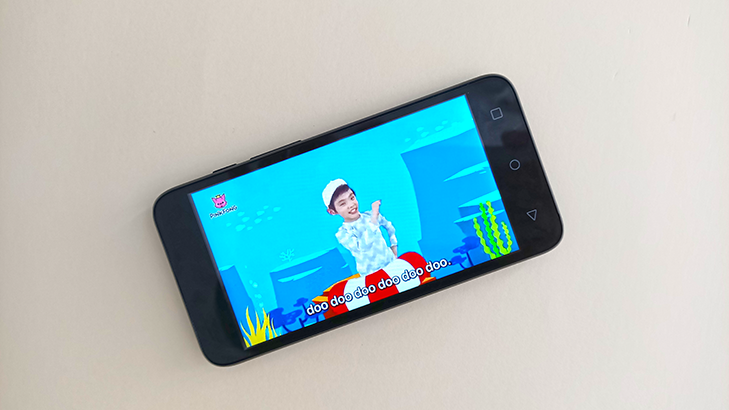
As a fully-fledged grown up, you’re probably going to be able to determine the emotion you’re feeling and act on it appropriately. If a device is operating slowly, videos are buffering, or your music doesn’t sound quite right, you might feel frustrated, or anxious. But you’re still more likely than someone 25 years your junior to wait out the storm, rather than personify it’s chaos.
Children are impatient, and will act out in unpredictable ways when that patience is tested - so it’s a good thing that the G-mee software is up to scratch. G-mee runs Android Go, which is a lightweight version of the Android operating system. Designed to use less processing power, and less storage, with streamlined Android apps (like Google Maps Go, YouTube Go, Gmail Go, and Google Assistant Go), the system suits the lightweight audience. The software runs smoothly, with fast enough responsiveness to stave off any misdirected frustration.
Considering that the G-mee Plus is a WiFi only device, buffering times and max video quality will be at the behest of your internet connection. However, using the YouTube Go app on the handset doesn’t disappoint, delivering adequate picture quality and clean audio. Once again, there is a notable difference between using a flagship device, and the G-mee - which mostly comes down to the screen resolution, and the gap between the screen and the display.
If it frustrates your little one, this can be a good opportunity to explore some of those emotions in a constructive way - and work on their patience at the same time.
Narcissism and empathy
Children find it difficult, nay, impossible to think about much more than themselves. It’s a proven concept that we don’t develop empathy until around the age of seven, which means that every time children apologise or share with someone else, they’re paying us lip service, and honestly bless them for that.
These narcissistic tendencies mean that if a situation isn’t going exactly how they want it to, they’re going to push back. So does the G-mee serve all the whims of a tiny, self-obsessed human being? When a toddler, or preschooler asks me for my phone it’s usually for one of three things; to play games, to take pictures, or to watch videos.
We’ve already established that watching videos on YouTube, and Netflix for that matter, on the G-mee is perfectly suitable for the audience, and it won't have trouble running games that aren't too demanding. There's only 8GB of internal storage, however, which isn't a lot. If all you want to do is install Netflix and Spotify for your kids, that's fine, but you may want to pick a microSD card if you're planning to download plenty of games or videos for offline viewing.
The only issue I can foresee is the missing camera; the G-mee Plus doesn't have a camera on the front or back. While the reasoning behind it is sound, no camera means your little one stays as private as possible, a handful of the most entertaining apps for kids use augmented reality through the camera. I’ve spent many hours with my nephews playing with Snapchat, or doing point and snap treasure hunts.
Children love themselves, and seeing a version of them with bunny ears usually brings a stream of coos, giggles and pleads for “more”. These activities could easily be picked up on your own device, where you can monitor and have control over the content, but if the point is to keep your phone to yourself, then the lack of a camera may defeat the purpose.
Impulsivity
For anyone who has spent more than 20 minutes with a child, it's clear that they act without consideration. Tantrums are par for the course, and they can include anything from tears to extreme feats of strength - if you've ever tried to wrestle a toy from a determined toddler then you know what I'm talking about.
For our last test, I wanted to see if the G-mee could hold up in a tiny human's tantrum. While the handset doesn't have a strict fall rating, handling it makes me confident it could take the destruction that ensues during a tantrum.
For the test, we replicated a few scenarios:
A casual drop from child texting height (50cm)

Although the bounce looks dramatic, the fall did nothing to hinder the G-mee Plus. Not a single scratch, or bump was to be seen, and the handset picked up right where it left off.
Grumpy toddler throws them self on the ground (100cm)

The plastic case added another big bounce from 100cm, replicating your usual temper tantrum of diving onto the ground in a huff. Once again the G-mee held it's own, taking the fall in stride without a scratch to show for it.
Full blown, throwing things across the room tantrum (150cm)

From 150cm, which is indicative of a super tantrum, the G-mee Plus still held up remarkably well. The back case came off slightly, dislodging the battery and switching the device off. But after restarting, the G-mee Plus runs as usual, without a single abrasion.
G-mee Plus - Final Thoughts
As a media device, specifically for young children the G-mee Plus does what it needs to do, and holds up against most of the factors that make kids kids. It can survive a tantrum, serve almost everything your self-obsessed munchkin may want to do, and it won't frustrate them in the process. If you need something for your children to watch videos on, listen to music, and play games, and you're not a fan of relinquishing your phone for their whims - then the G-mee Plus might be the answer.
But I guess the real question, is whether there is a need for this device at all?
Given how affordable budget smartphones have become, they might be the better option. Realistically, for the G-mee Plus' RRP of $120 you can get an entry-level smartphone that has things the G-mee is missing. Namely a camera, access to a mobile network (it's also worth noting that there's a slightly pricier G-mee device with 4G connectivity if you want a phone without a camera).
Nothing stops you from enabling parental controls on a cheap smartphone, removing the SIM card and using that in lieu of the G-mee. When your little one is ready to be connected to the world, you can simply slide in a SIM card and save yourself forking out for a new device.
As a whole, the G-mee is a practical device that has clearly been thought through for its child users, and there is definitely a place for it, just not in my (hypothetically child-filled) family.
Pick one up direct from the source at g-mee.com.
Anula Wiwatowska
Offsite Editorial Lead | Instagram

Related Articles


