

HTC is launching its latest premium smartphone - the U12+ - with a clear message: there's "just one flagship this year".
Thomas Dexmier, HTC's Country Head for Australia and New Zealand, says the company doesn't want to upset its fans by releasing a new variant in just six months, so this time around there won't be other models. No U12 Ultra, no U12 Play, no plain and simple U12.
Instead, Dexmier says HTC went with the name "U12+" because the company wants it to be "benchmarked against the 'Pluses' and the 'Pros'" from other manufacturers.
The HTC U12+ is mostly par the course for a top-tier 2018 device: it has an extra-tall 18:9 display (with no notch), facial recognition, a glass back, no headphone jack (you'll find USB Type-C buds with noise cancelling in the box), and two rear-facing cameras.
There are however a couple of unique features. Firstly, one of the colourways has a translucent blue back, that partial reveals the hardware within; it's like a glossier, bluer take an "atomic purple" GameBoy. We don't know what colour options are coming to Australia, but we're certainly hoping translucent blue is one of them.
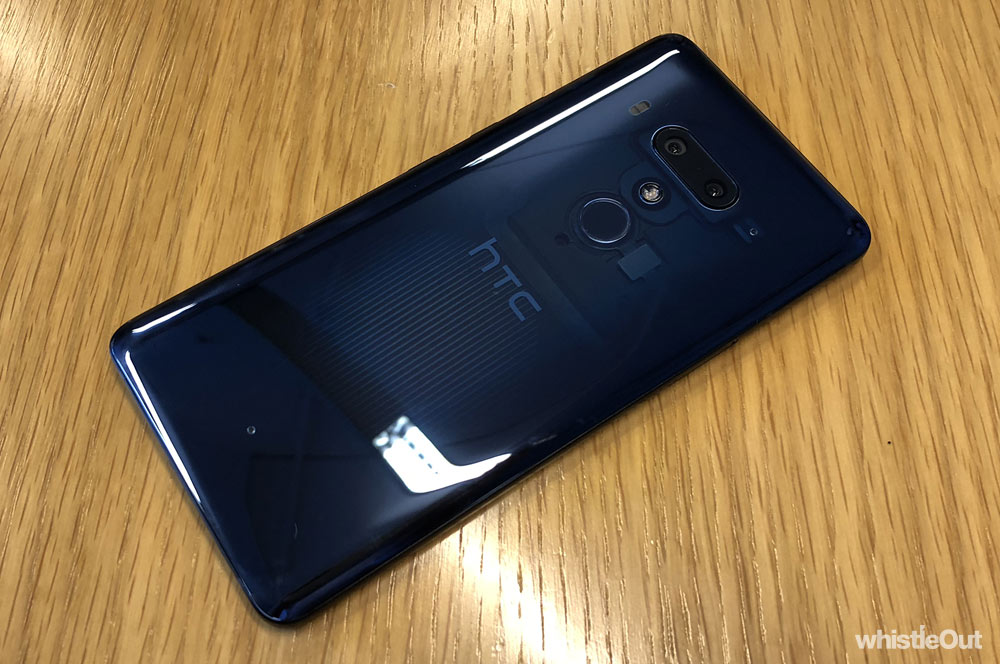
Secondly, Edge Sense is back and sounds more useful this time around. As with the U11, you can squeeze the U12 to trigger an action, such as bringing up Google Assistant or launching the camera. A long squeeze and a short squeeze can trigger difference actions.
You're now also able to double tap either side of the phone to trigger a different action; by default this will launch a one-handed mode that shrinks the interface and pins it to the side you tapped.
The most useful new feature is arguable the simplest: if you're holding your phone, Edge Sense will lock its orientation. If you're lying down, your phone won't keep flipping between portrait and landscape as long as you have a decent grip. Loosening your grip allows the orientation to change again.
HTC's doubled down on the idea of Edge Sense and replaced all physical buttons with pressure sensitivity "bumps" on the frame. Since these aren't mechanical, there's less risk of failure, and extra protection against dust and water.
We loved the camera on last year's U11, and the U12+'s is set to be even better, with Dexmier calling the improvement "beyond what we usually deliver from one flagship to another". This is backed up by a DxOMark score of 103, making the U12+ arguably the second camera phone on the market, behind the Huawei P20 Pro's score of 109.
While DxOMark is a good indicator of sensor quality, it doesn't necessarily account for real world usage. However, we found the U11's camera was fast to shoot and rarely flubbed a shot, so we're hoping this is the same case this time around.
The U12+'s camera configuration is made up a 12MP and 16MP lens on the back, and two 8MP on the front. The secondary cameras are used for DSLR-like bokeh on both the front and back, and the secondary lens on the back can be used for 2x optical zoom.

Key specifications for the U12+ include a 6-inch Quad HD+ display, a Snapdragon 845 processor, 6GB of RAM, either 64GB or 128GB of expandable storage, IP68 water-resistance, and a 3,500mAh battery.
Local pricing, availability, and colours for the U12+ have yet to be confirmed, although we're expecting to see it sooner than later. In terms of price, we'd like to see the U12+ come in at $999, like last year's U11.
Alex Choros

Related Articles


