
Telstra is one of the few providers with mobile plan discounts for pensioners or seniors. The telco has recently implemented a flat 10% discount on its Upfront plans for various concession card holders, including the Pensioner Concession Card.
But before you jump into a new Telstra plan, you can usually save more money by taking a different route. Many plans from smaller providers – called MVNOs – offer more data for a lower price. By choosing a smaller telco, you can get a cheaper plan without even needing a pensioner or seniors discount card. But it's not entirely without trade-offs.
Telstra Upfront plans for seniors
Telstra is one of the few providers to offer discounts on mobile plans for pensioners with a concession card. If you have a Pensioner Concession Card, you get a flat 10% off any Telstra Upfront plan (excluding the special Upfront Mobile Access Plan). These are Telstra's standard postpaid plans, which can be SIM-only or paired with a mobile phone repayment plan.
People who have a Health Care Card or Veteran Affairs Gold Card are also eligible for this discount.
While any discount is nice, 10% doesn't even nearly make up the difference in price between Telstra and most other mobile providers. Even Boost Mobile is significantly cheaper, which is your only other option if you want access to the full Telstra network.
Telstra's Upfront plans currently start at $74 per month with 50GB of data. Not only is this a high price for a mobile plan, 50GB is way more data than most people need. According to the ACCC, the average postpaid user in Australia only goes through 19GB per month. By and large, we'd advise against paying for data you're not using.
That said, Telstra's Upfront plans aren't without additional perks, such as Telstra Satellite Messaging, inclusions for international calls, and international roaming, among others.
Here's a look at Telstra's postpaid plans:
|
#1
|
Telstra

$84 Essential Upfront SIM Plan
$74.00/mth
Min. cost $74
Link not supplied
|
|
#2
|
Telstra
$74 Basic Upfront SIM Plan
$74.00/mth
Min. cost $74
Link not supplied
|
|
#3
|
Telstra
$99 Premium Upfront SIM Plan
$84.00/mth
Min. cost $84
Link not supplied
|

Telstra prepaid plans for seniors
While Telstra's prepaid plans don't offer special discounts for seniors, they can still be a much cheaper option for most people. That's in part because the smallest plans have much less data, so you waste less money on data you don't need.
They generally include bonus data for the first three recharges, after which they drop to their standard amount. For example, the cheapest plan starts with 60GB before dropping to 20GB. This might not sound like much, but it's well within the average national usage of 9GB for prepaid plans (or 19GB for postpaid plans).
You do need to keep in mind that these plans have a 28-day recharge, however. That means you'll be paying at least 13 bills per year, instead of 12.
Ultimately, while Telstra's prepaid plans are cheaper than its Upfront ones, you can still get a cheaper deal elsewhere. But if you're still keen on getting a plan directly from Telstra, here are Telstra's prepaid plans:
|
Telstra
$44 Pre-Paid Mobile
$44.00
Per 28 Day Renewal
Link not supplied
|
|
Telstra
$54 Pre-Paid Mobile
$54.00
Per 28 Day Renewal
Link not supplied
|
|
Telstra
$64 Pre-Paid Mobile
$64.00
Per 28 Day Renewal
Link not supplied
|
|
Telstra
$74 Pre-Paid Mobile
$74.00
Per 28 Day Renewal
Link not supplied
|
Telstra also has long-expiry mobile plans that can be a bit cheaper in the long term. For example, a single payment of $395 will pay your phone bill for the year, which works out to be the equivalent of around $33 per month. This plan currently includes 330GB for the whole year, which will drop to 180GB from your second recharge onward.
Here's a look at Telstra's long-expiry prepaid plans:
|
Telstra
$200 Pre-Paid Mobile Plan
$200.00
Per 6 Month Renewal
Link not supplied
|
|
Telstra
$395 Pre-Paid Mobile Plan
$395.00
Per 12 Month Renewal
Link not supplied
|
Telstra vs. Telstra MVNOs
An MVNO is a smaller telco that buys access to one of the three national mobile networks, respectively run by Telstra, Optus, and Vodafone. Plans from MVNOs are cheaper than comparable ones from the Big Three. They also have better options to accommodate average or low-data users.
For example, Telstra's smallest SIM-only plan has 50GB of data – more than double the average national usage of 19GB for postpaid customers. In comparison, you can pick up Telstra MVNO plans with 30GB, 20GB, or less. Not only can they be cheaper per gigabyte, you're not roped into paying for data you don't need.
Telstra MVNOs do have one big downside: coverage. Other than Boost Mobile, they all operate via the smaller Telstra Wholesale network. While the full network spans a huge 2.14 million square kilometres, the Wholesale network is just 1.4 million, which is just a tad bigger than the 1.2 million of the Optus and Vodafone networks. And these figures are for 4G.
Unfortunately, there aren't any recent figures to directly compare the 5G coverage of Telstra's two networks. Nevertheless, here's a broad overview of what each coverage map looks like:
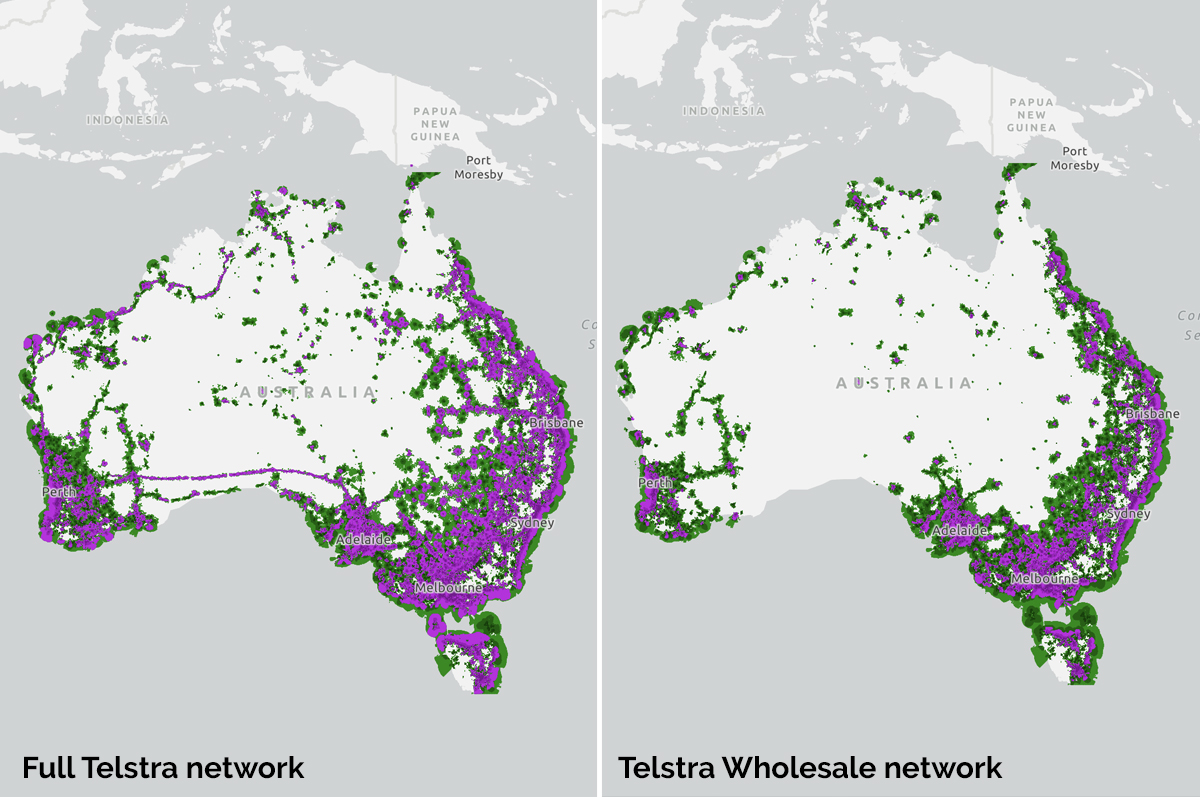
Suffice to say, if you want that famous Telstra coverage, you need a plan from Telstra or Boost Mobile.
Telstra plans also sometimes come with bonuses, like discounts on streaming services and perks like cheap movie tickets through Telstra Plus. Conversely, MVNO plans tend to be bare-bones. But given how much of a premium you pay for being on a plan from Telstra itself, you'll need to decide if the markup is worth it.
The last major difference applies if you're after a new phone. Telstra will sell you a phone on a repayment plan with a 12-, 24-, or 36-month contract, which you also pair with a Telstra Upfront mobile plan. But MVNOs offer SIM-only or prepaid plans, meaning you'll have to bring your own phone.
But the BYO option does usually work out to be much cheaper in the long run. Barring special deals, phone repayment plans still charge you full retail price for the phone. Yes, you pay it off more slowly, but you're also stuck on a Telstra plan for the duration. On the other hand, buying the phone outright means you can sign up to a cheaper plan from a Telstra MVNO, saving you money in the long run.
Boost Mobile plans
Boost is the only other provider with full access to the Telstra network, so it's your only option if you want that big Telstra coverage without paying the Telstra premium.
This telco sells prepaid plans that, while more expensive than most other MVNOs, can be significantly cheaper than those from Telstra itself. Like Telstra, the standard prepaid plans have a 28-day recharge and come with bonus data for the first three. After that, the included data can drop pretty significantly, but it's still solid data-to-dollar value when put up against Telstra plans.
The cheapest plan is only available via eSIM, which is unusual. But the rest can be via eSIM or a standard SIM card. Here's a look at Boost's 28-day plans:
|
Boost Mobile

$28 Prepaid
$28.00
Per 28 Day Renewal
|
|
Boost Mobile
$39 Prepaid
$39.00
Per 28 Day Renewal
|
|
Boost Mobile
$49 Prepaid
$49.00
Per 28 Day Renewal
|
|
Boost Mobile
$59 Prepaid
$59.00
Per 28 Day Renewal
|
|
Boost Mobile
$74 Prepaid
$74.00
Per 28 Day Renewal
|
Boost also has long-expiry plans. Once again, like Telstra these have bonus data for the first recharge (one year or six months, plan depending), and can work out to even better value over the course of a year.
|
Boost Mobile
$180 Prepaid
$180.00
Per 6 Month Renewal
|
|
Boost Mobile
$300 Prepaid
$300.00
Per 12 Month Renewal
|
|
Boost Mobile
$365 Prepaid
$305.00
Per 12 Month Renewal
|
Telstra network plans $30 and under
There's a selection of smaller providers on the Telstra network that offer cheaper plans than Telstra. Almost all of them deliver their mobile coverage via the Telstra Wholesale network, but most Aussies should still find themselves well within range. The exception is Boost Mobile, which has access to the full Telstra network (but is still quite a bit cheaper than Telstra).
And while MVNO plans generally have fewer bells and whistles, some still include handy perks like data banking, international roaming options, and international call inclusions.
Here's a range of popular Telstra network plans starting under $30 per month:
|
Superloop

SuperSim Saver 4G Plan
$25.00
Per 30 Day Renewal
|
|
ALDI mobile

$28 Mobile Plan
$28.00
Per 30 Day Renewal
Link not supplied
|
|
Everyday Mobile

Pre-paid Mobile $25 Recharge
$25.00
Per 30 Day Renewal
Link not supplied
|
|
Boost Mobile
$28 Prepaid
$28.00
Per 28 Day Renewal
|
|
EZEE Mobile

29GB Mobile SIM Plan
$29.00
Per 30 Day Renewal
Link not supplied
|
Prepaid plans
Prepaid plans charge you at the beginning of a billing cycle and grant you a set amount of data for use within that period. The most common period length is "monthly", which can be 28-days, 30-days, or recurring on the same numbered date of each month. You can also elect to recharge manually or automatically.
If you go over your data limit, your mobile internet access gets cut off. At this point, you can recharge again (pay a new full bill) or, if your provider offers them, purchase a data add-on pack to get you to the next recharge. But you won't be completely cut off from contact because modern prepaid plans have unlimited standard national calls and texts, which you keep access to for your whole recharge period, even if you go over your data limit.
There's a general idea out there that prepaid plans are cheaper than postpaid plans. While this is generally the case when comparing the SIM-only and prepaid plans of an individual telco like Optus, it's not necessarily the case when you look at the whole mobile industry.
SIM-only plans
There aren't many Telstra MVNOs with SIM-only plans for less than Telstra's mobile plan for pensioners. Almost all plans labelled as "SIM-only" are postpaid plans, which charge you at the end of each billing cycle. You can think of them as a monthly subscription service – if you miss a payment or two in a row, you keep full access to your plan but might have to pay an overdue fee.
To muddy the waters, some SIM-only plans charge you at the start of each billing cycle, but are otherwise the same. These generally labelled along the lines of "upfront" plans, but are also pretty uncommon.
If you go over your data limit on a SIM-only plan, you don't get cut off. Usually, you're automatically charged an overage fee based on how much you went over by. Like prepaid, modern SIM-only plans also have unlimited standard national calls and texts.
Alex Choros

Related Articles


