

LG's laid out its first-half-of-2017 TV roadmap for Australia, and there's great news for those with money to burn and hardcore Netflix bingers alike.
Headlining LG's 2017 range of TVs is an almost impossibly thin 4K OLED set - the Signature W7 - designed to be wall mounted on magnetic brackets. The panel itself is 2mm thin, and the wall mount adds another 2mm to the unit. Try and spot it in the below photo.
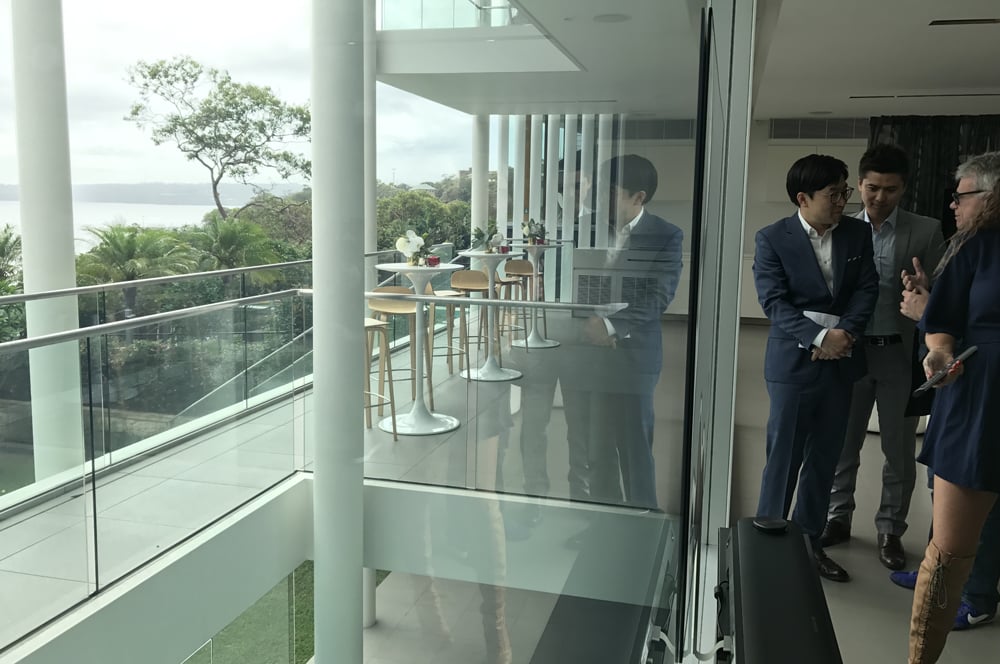
All of the W7's inputs have been relegated to a Dolby Atmos ready sound bar that comes bundled in the box, including power and HDMI. This connects back to the TV over a ribbon cable that LG envisages you'll plaster over.

Of course, bleeding edge design will set you back a pretty penny: the 65-inch Signature W7 will retail for $13,499 when in launches in the first week of April. An installation service is however included in the price of TV.
Even if you're not keen on dropping almost $14,000 on LG's latest high-end TV, its entire 2017 OLED, Super UHD, UHD, and Full HD TV range have a few nifty features that avid streamers are sure to love.

The revamped "Magic Remote" has dedicated buttons for Netflix and recently launched Amazon Prime Video, and the traditional 0 to 9 channel buttons can also be used as shortcuts to fire up other SVOD apps. These will include Stan, YouTube, iView, and Google Play Movies & TV. Notably, LG's new TVs will be some of the first to support 4K streaming through Stan after the local streaming service switches on access to ultra high definition content in April.
During the TVs' local launch, LG Australia General Marketing Manager Angus Jones pointed to the importance of streaming and how it's rapidly changing the ways in which Australians are consuming content as a key influence in the design of the new TVs.
Other new operating system features include the ability to playback 360-degree video on the TV while using the remote to explore the picture, and voice-driven content search able to query multiple services for movies and shows.
In terms of LG's overall line-up, here's a quick look at what's new.
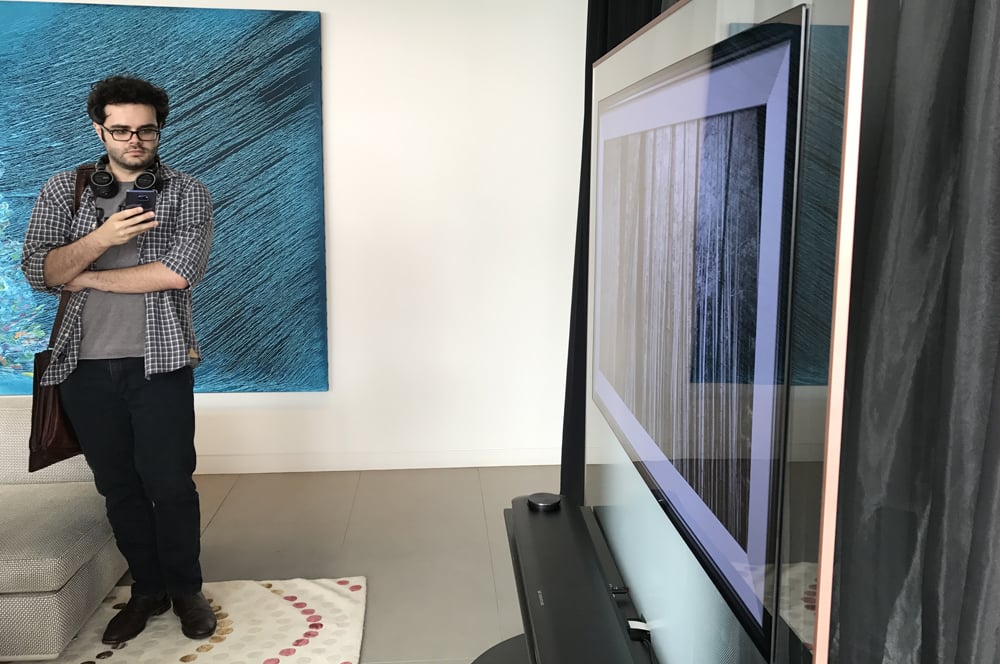
OLED
For those not familiar with OLED televisions, they don't use a backlight. Individual pixels are lit up on a case-by-case basis, which allows for what LG's marketing department refer to as "perfect black". Essentially, if a pixel on an OLED TV isn't being used to display a colour, it switches itself off entirely. If, for some reason, you were looking at a black screen, you actually wouldn't be able to tell if an OLED panel is on or off.
On a conventional TV, you'd still see a faint backlight behind black areas, or alternatively, haloing in the case of local dimming.
In turn, "perfect black" also means OLED TVs can provide better contrast and colour accuracy.
LG's 2017 OLED TVs are 25% brighter than last year's models, now support four different HDR options - Dolby Vision, HDR10, HLG (broadcast HDR), and YouTube HDR, and all have Dolby Atmos ready audio systems.
- 65-inch LG Signature W7 OLED TV - $13,499
- 65-inch LG Signature G7 OLED TV - $9,099
- 65-inch LG Signature E7 OLED TV - $7,999
- 55-inch LG Signature E7 OLED TV - $5,199
- 65-inch LG Signature C7 OLED TV - $6,899
- 55-inch LG Signature C7 OLED TV - $4,099
These will go on sale between March and May.

Super UHD
LG's 2017 family of Super UHD TVs mixes quantum dots with a new Nano Cell coating that the company says delivers purer colours, more accurate colours when viewed at an angles, darker blacks (although not OLED black), and less reflections.
Like the 2017 OLEDs, LG's 2017 Super UHD TVs now support four different HDR options - Dolby Vision, HDR10, HLG (broadcast HDR), and YouTube HDR.
- 86-inch LG SJ95 Super UHD TV - $14,699
- 75-inch LG SJ95 Super UHD TV - $8,199
- 65-inch LG SJ85 Super UHD TV - $4,799
- 60-inch LG SJ85 Super UHD TV - $3,799
- 55-inch LG SJ85 Super UHD TV - $3,199
- 65-inch LG SJ75 Super UHD TV - $4,199
- 55-inch LG SJ75 Super UHD TV - $2,899
- 49-inch LG SJ75 Super UHD TV - $2,099
These will go on sale between March and May.
So what’s Dolby Vision?
Dolby Vision is one of the major competing high dynamic range (HDR) video standards currently fighting it out for supremacy. There's two parts to HDR: the display, and the content.
A HDR ready display has a higher contrast ratio than a typical TV; essentially the difference between how bright and dark it can go. This also results in a wider colour space, and as such a more true to life image.
HDR content refers to movies or TV shows that have been optimised for HDR displays. Dolby Vision is one of the major formats that allow content producers to make their content HDR ready. HDR10 and Dolby Vision are the two main HDR10 content standards currently being used.
While both standards tell HDR compatible displays - such as the 2017 LG OLED and Super UHD TVs - how to display content, HDR10 has one set piece of instructions per movie or episode. Dolby Vision is more dynamic, and is capable of providing instructions on a frame-by-frame basis.
Notably, HDR video, such as Dolby Vision encoded footage can increase your data usage depending on how it's been mastered.
If your streaming service of choice is using an adaptive solution (such as Netflix), you can expect to use somewhere between 10% and 15% more data. If you were streaming 4K Dolby Vision content through Netflix, you'll likely need an additional 2Mbps to 3Mbps of bandwidth on top of the 25Mbps Netflix says you need for optimal 4K.
On the other hand, Amazon Prime Video simply hosts two different versions of video on its servers: the regular version, and a Dolby Vision ready version. The Dolby Vision ready version should typically have similar bandwidth requirements to what you'd normally stream.
At present, Australians can only access Dolby Vision content through Netflix and Amazon Prime Video. Dolby Vision ready 4K Blu-Ray players and Dolby Vision encoded 4K Blu-Rays will be coming later this year.
Everything else
LG will also have six new UHD 4K TVs ranging between 43-inches and 75-inches in size, and two new Full HD TVs (32-inch and 43-inch) launching between March and May. These will run the latest version of LG's smart TV operating system - Web OS 3.5 - and ship with the aforementioned 2017 Magic Remote.
Alex Choros

Related Articles


Find a Better Pay TV Package
Compare options from Foxtel, Fetch TV, Netflix, Stan and more.


